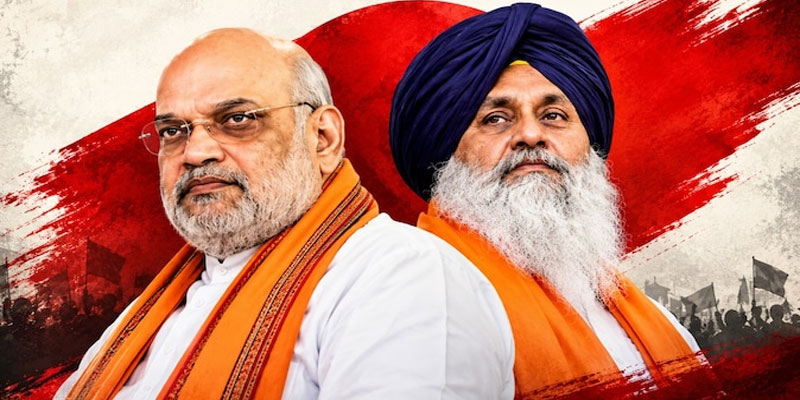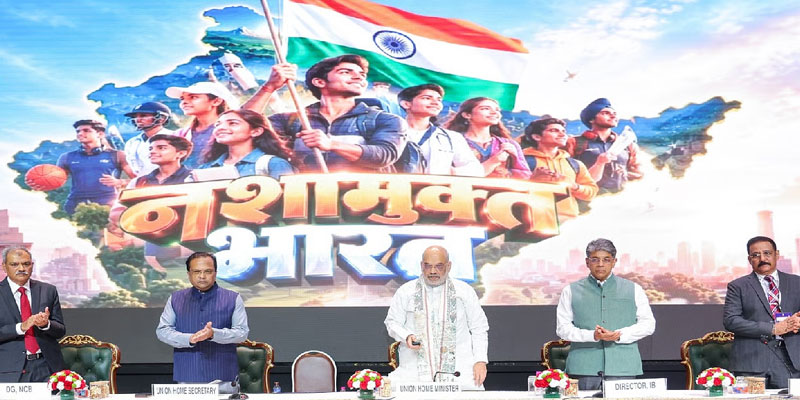
Addressing a gathering while flagging off 'Run for Unity' in New Delhi on 'National Unity Day', Union Home Minister Amit Shah underscored that if India were to become 'viksit' (developed), it needs to become drug-free.
Union Home Minister Amit Shah on Saturday targeted the opposition veiledly and underlined that India's linguistic, cultural and traditional diversity are a strength for the country, describing them as Sardar Vallabhbhai Patel's message that needs to be followed.
He also applauded Prime Minister Narendra Modi for abrogating Article 370 that ensured the permanent integration of Jammu and Kashmir with India. Further, he said Naxalism has been completely eradicated from India and the implementation of a unified tax system would help in further developing the country.
However, the Bharatiya Janata Party (BJP) leader underscored that if India were to become 'viksit' (developed), it needs to become drug-free. For creating a drug-free India, several significant tasks have been accomplished, he said, calling it vital for the country's youth and the future.
"Today, on the birth anniversary of Sardar Patel, I appeal to the people across the nation regarding the goal we have set: to make the country completely free from drugs by December 31, 2029," he said before flagging off 'Run For Unity' at the Major Dhyan Chand National Stadium in New Delhi.
"The vision of a 'Viksit Bharat', as envisioned by the Prime Minister, begins with the creation of a 'Nasha-mukt Bharat' (Drug-free India)," he said before flagging off 'Run For Unity'," he added.
The union minister also saluted Sardar Patel for helping forge a united India within just 1,218 days following the Independence. He said Sardar Patel achieved this feat which many described as impossible, adding that the country built by him now stands before the world with pride.
He said under PM Modi, Sardar Patel's birth anniversary is observed as 'National Unity Day' (Rashtriya Ekta Diwas) to salute the 'Iron man of India'.
"He was a great personality who not only transformed the nation's history but also shaped its very geography," Shah said in his address.
"By undertaking the arduous task of uniting numerous princely states, weaving them all together like beads on a single string, Sardar Sahab became the architect of the map of an 'Akhand Bharat' (undivided India) as we see it today. He did not merely make successful efforts toward the geographical, political, and cultural integration of India; he effectively brought these elements together, binding the nation into a single, unified whole," he said