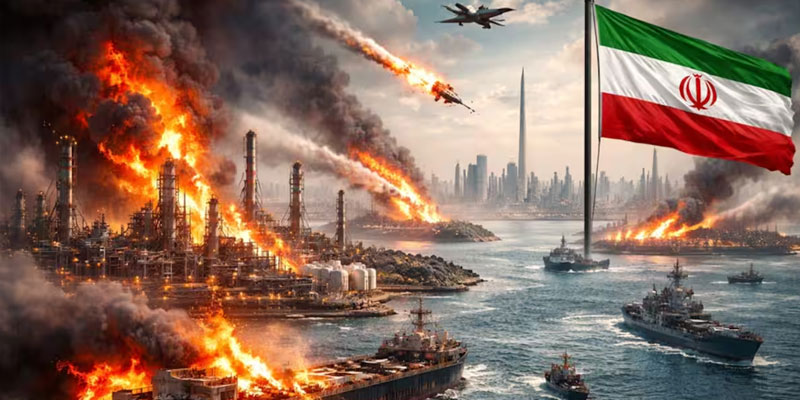
Kuwait Strike Signals a Wider Escalation
As the West Asia conflict approaches its third week, Kuwaiti officials have confirmed a direct attack on a domestic oil refinery—an alarming signal that the war is expanding beyond isolated strikes into a broader campaign targeting critical energy infrastructure. What began as a series of missile exchanges has now evolved into a calculated effort to disrupt the economic lifelines of Gulf nations. With hydrocarbon facilities across the region increasingly vulnerable, the escalation marks a turning point where energy security and military strategy are becoming inseparable.
Iran’s LNG Shock: A Structural Blow to Global Markets
Iran’s missile strikes on Qatar’s Ras Laffan Industrial City have pushed the conflict decisively into the energy domain. The damage is not symbolic—it is deeply structural. According to QatarEnergy, roughly 17 percent of the country’s liquefied natural gas (LNG) export capacity has been knocked offline. The shutdown of key LNG trains, including Trains 4 and 6, alongside a major gas-to-liquids facility, represents a production loss of 12.8 million tonnes per annum.
The financial impact is equally severe, with estimated annual losses reaching $20 billion. More critically, the timeline for recovery—three to five years—means this is not a temporary disruption but a prolonged contraction in global LNG supply. Qatar has already declared long-term force majeure on key export contracts affecting Europe and Asia, including major buyers in Italy, Belgium, South Korea, and China.
This creates a ripple effect across global gas markets. With one of the world’s largest LNG exporters constrained, supply-demand balances tighten, prices rise, and energy-importing nations are forced into fierce competition for alternative sources. The result is a sustained period of volatility and strategic uncertainty.
Expanding Targets and Trump’s Warning
Iran’s strikes have not been limited to Qatar. The confirmed attack in Kuwait underscores a broader pattern: Gulf energy infrastructure—from Saudi refineries to facilities in the UAE—is now within Tehran’s operational scope. This widening target set has injected a lasting risk premium into global oil and gas markets, as traders’ factor in both current disruptions and the likelihood of further strikes.
Amid this escalation, Donald Trump has issued stark warnings. While reportedly urging restraint on Israeli strikes against Iranian gas assets, he simultaneously threatened overwhelming retaliation if Iran escalates further. This dual posture reflects the delicate balance between deterrence and de-escalation, but also highlights the risk of miscalculation in an already volatile environment.
Breaking the Strait of Hormuz Blockade
The conflict’s maritime dimension is rapidly intensifying. Iran’s actions in the Strait of Hormuz—including harassment of commercial vessels—have elevated concerns about the security of one of the world’s most critical energy corridors. In response, six nations—the United Kingdom, France, Germany, Italy, the Netherlands, and Japan—have signaled readiness to coordinate a joint naval effort to ensure safe passage.
This emerging coalition reflects a broader internationalization of the conflict. Securing maritime routes is no longer just a regional concern but a global imperative, given that a significant portion of the world’s oil and LNG flows through this narrow passage.
From Conflict to Systemic Crisis
Taken together, the attacks on Qatar’s LNG infrastructure, the strike in Kuwait, escalating rhetoric from global powers, and the looming multinational naval response mark a profound shift in the nature of the conflict. This is no longer a contained regional war—it is an unfolding energy and maritime crisis with global consequences.
With nearly a fifth of Qatari LNG capacity offline for years and Gulf infrastructure under sustained threat, the world faces a structural energy shock. At the same time, the militarization of key sea lanes raises the specter of prolonged geopolitical confrontation. The stakes are no longer just territorial or political—they are systemic, reshaping energy security and global stability for years to come.
(With agency inputs)