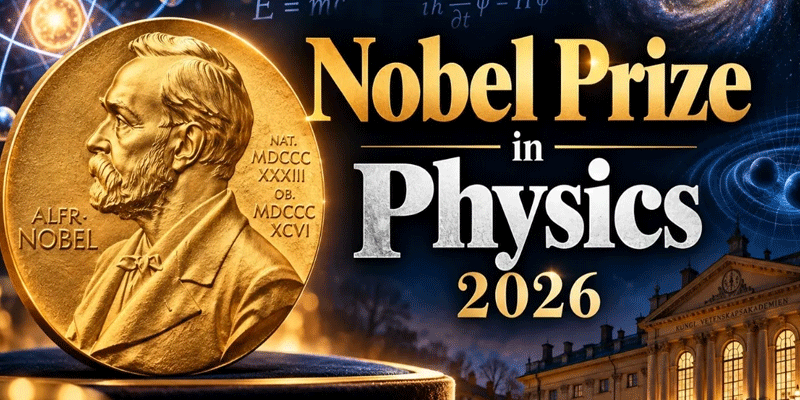
Francis Halzen has won the 2026 Nobel Prize in Physics for his decisive role in developing the IceCube Neutrino Observatory and revealing high-energy neutrinos originating from powerful cosmic sources. The Royal Swedish Academy of Sciences announced the award on October 6, recognising a decades-long scientific vision that transformed Antarctic ice into a giant telescope for exploring the universe.
A Vision Born at the South Pole
Born in Tienen, Belgium, in 1944, Halzen earned his doctorate from KU Leuven in 1969 before building his academic career at the University of Wisconsin–Madison. In 1988, he proposed using the enormous volume of Antarctic ice at the South Pole to detect elusive neutrinos.
Neutrinos are electrically neutral subatomic particles produced in nuclear reactions and some of the universe’s most violent events. They interact extraordinarily weakly with matter, allowing trillions to pass through Earth almost undetected.
That very characteristic makes them scientifically valuable. Unlike light, which can be absorbed or scattered, and charged cosmic rays, whose paths are bent by magnetic fields, neutrinos can travel vast cosmic distances largely undisturbed and point researchers towards their sources.
IceCube Turns Antarctic Ice into Telescope
The IceCube Observatory uses roughly a cubic kilometre of exceptionally clear Antarctic ice as a gigantic particle detector. More than 5,000 light sensors were embedded deep beneath the surface to detect faint flashes generated when neutrinos interact with atomic nuclei.
Construction was completed in 2011 after years of engineering and logistical challenges in one of the planet’s most inhospitable environments. Halzen’s contribution was therefore not simply theoretical; it involved transforming an unconventional concept into a functioning international scientific facility.
A New Window on the Violent Universe
The detection of high-energy neutrinos from astrophysical sources established neutrino astronomy as a powerful new field and strengthened the broader era of multi-messenger astronomy.
IceCube observations can help scientists investigate:
· Powerful particle accelerators beyond the Milky Way.
· Active galactic nuclei and other extreme cosmic environments.
· Supernovae and potentially other transient events.
· The mechanisms producing particles at energies far beyond terrestrial laboratories.
The significance lies in neutrinos carrying information from regions of the universe that conventional telescopes may struggle to observe directly.
2026 Nobel Season Enters Its Decisive Phase
Halzen’s Physics prize forms part of the 2026 Nobel announcements being released this week. The awards recognise discoveries and achievements across several fields, with the Nobel announcements traditionally unfolding over successive days before the prizes are formally presented on December 10, the anniversary of Alfred Nobel’s death.
The Physics award carries a 12-million-kronor prize, underscoring the international importance attached to fundamental scientific breakthroughs.
From Antarctic Ice to a New Era of Astronomy
Halzen’s Nobel recognition illustrates how a seemingly improbable scientific idea can become transformative when sustained by technological innovation, international collaboration and decades of persistence. IceCube has done more than detect elusive particles: it has opened another observational channel into the universe.
The achievement ultimately demonstrates that some of the biggest discoveries in physics may come not from building ever-larger conventional telescopes, but from finding entirely new ways to observe nature. By turning a vast expanse of Antarctic ice into a cosmic detector, Halzen helped give humanity a new way to listen to the universe.
(With agency inputs)