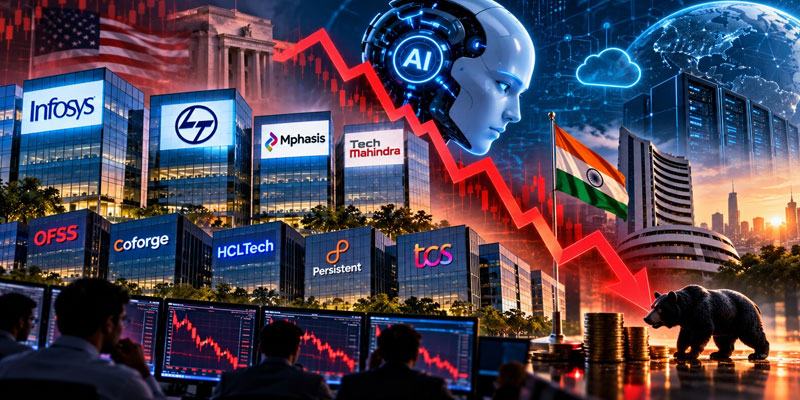
Global Technology Sell-Off Creates a Sharp Market Divide
Why are the Sensex and Nifty rising while major markets in the US, Japan and South Korea are bleeding? Asian stocks have tumbled following a sharp technology-led sell-off on Wall Street, driven by concerns over artificial intelligence (AI) investments, semiconductor demand and tighter US regulations. However, Indian equities have moved in the opposite direction, extending their recent gains. The divergence reflects differences in market composition, falling crude oil prices and foreign investment flows rather than any immunity from global financial turbulence.
Wall Street's AI Rout Spills into Asia
The global sell-off gathered momentum on November 6, 2026, after investors reassessed the enormous valuations and spending commitments surrounding AI infrastructure. Concerns that technology companies could face slower AI investment growth and tougher regulatory scrutiny triggered heavy selling in US technology stocks, pushing the Nasdaq into correction territory.
The weakness quickly spread across Asian markets, particularly economies heavily dependent on semiconductor manufacturing and AI-related hardware.
· South Korea: The KOSPI plunged more than 8%, triggering a circuit breaker.
· Japan: The Nikkei dropped approximately 5–7%, reflecting pressure on major technology and semiconductor companies.
· Taiwan: Its technology-heavy market also witnessed significant losses.
The sell-off particularly affected companies such as Nvidia, Samsung Electronics, SK Hynix, TSMC, Tokyo Electron and Kioxia.
Why Asian Markets Are Bearing the Brunt
The disproportionate impact on Asian markets is largely explained by their heavy exposure to the global semiconductor and AI supply chain. South Korea, Japan and Taiwan have significant index weightings in companies manufacturing chips, semiconductor equipment and advanced electronic components.
As investors question whether the enormous investments in AI data centres will generate sufficient returns, expectations of future chip demand have weakened. This has prompted investors to reassess valuations and reduce exposure to technology stocks.
Another indication of global nervousness is the movement of capital towards safer assets. US Treasuries and Japanese and Chinese government bonds have attracted demand, while the dollar has weakened against traditional safe-haven currencies such as the yen and Swiss franc.
Why Sensex and Nifty Are Moving Higher
Indian equities have demonstrated relative resilience. At 10:13 a.m. on November 6, the BSE Sensex stood at 79,821.28, gaining 511.27 points (0.64%), while the Nifty 50 rose 103 points (0.42%) to 24,639.60.
Three factors explain this performance:
· Falling crude prices: Brent crude slipped below $100 per barrel, easing India's import burden, inflationary pressures and corporate costs.
· Foreign investment: Strong foreign institutional inflows have supported domestic equities and improved investor sentiment.
· Sectoral composition: India's benchmarks have greater exposure to banking, financial services, energy, infrastructure and consumption than semiconductor manufacturing.
What the Global Turmoil Means for India
India is not completely insulated from the global AI correction. A prolonged slowdown in technology investments could affect Indian IT services, electronics exports and technology-sector valuations. Sustained global risk aversion could also create pressure on the rupee.
However, lower oil prices offer an important economic advantage to India, which remains heavily dependent on imported crude. Supply-chain diversification could also create opportunities for India's emerging electronics and semiconductor industries.
India's Resilience, Not Immunity, Is the Real Story
The contrasting market movements underline how global financial shocks affect economies differently. While semiconductor-heavy Asian markets are suffering from uncertainty surrounding AI investments, India's relatively diversified equity structure, cheaper crude and foreign inflows are providing support. However, investors must distinguish between short-term market momentum and underlying economic strength. If the global technology correction deepens, Indian equities could eventually face spillover pressures. For now, the Sensex-Nifty rally demonstrates relative resilience, but sustaining it will depend on domestic earnings, investment flows and global economic stability.
(With agency inputs)