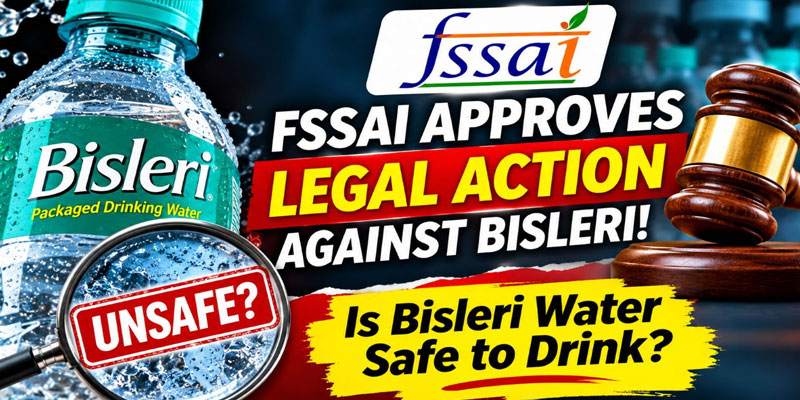
The Food Safety and Standards Authority of India (FSSAI) has found one packaged drinking-water sample from Bisleri's Goa facility exceeding the prescribed bromate limit, while a subsequent referral laboratory flagged potentially carcinogenic polycyclic aromatic hydrocarbons (PAHs). The findings have prompted the food regulator to grant prosecution sanction against Bisleri International Pvt Ltd, triggering a dispute over testing results, product safety and regulatory interpretation.
What Triggered FSSAI's Action?
On November 22, 2026, FSSAI announced that it had sanctioned prosecution against Bisleri under the Food Safety and Standards Act, 2006. The action followed testing of a packaged drinking-water sample collected from the company's registered Goa facility on September 30, 2025.
According to Bisleri, FSSAI collected six samples, of which five complied with applicable standards. The sixth reportedly contained bromate at 12 micrograms per litre against the permissible limit of 10 micrograms per litre, representing a 20% exceedance.
Following the company's appeal, a referral laboratory reportedly found bromate within permissible limits but detected polynuclear aromatic hydrocarbons (PAHs), resulting in another adverse safety assessment.
Bromate can form during certain water-treatment processes, particularly ozonation, while PAHs comprise a group of chemical compounds, some of which are recognised carcinogens. Their detection raises legitimate questions about water quality and consumer safety.
Bisleri Challenges the Findings, Assures Consumers
The company presented several arguments:
· Limited sample issue: The controversy concerns one sample from a particular batch at one of its 143 manufacturing plants.
· Testing discrepancy: The initial bromate reading was marginally above the limit, whereas the referral laboratory reportedly found it compliant.
· Independent verification: Bisleri submitted February 2026 test results from FSSAI-approved independent laboratories, claiming chemical levels were within permissible limits.
· Quality assurance: The company highlighted its 10-step manufacturing process and more than 90 quality checks.
Regulatory Concerns and Consumer Reactions
The prosecution sanction has intensified consumer concerns because packaged drinking water is a daily essential. However, sanctioning prosecution does not establish guilt; the allegations remain subject to legal adjudication.
Consumer Trust Must Prevail Over Disputes
The controversy highlights the importance of transparent food-safety enforcement and scientifically consistent laboratory testing. While Bisleri deserves an opportunity to present its defence, FSSAI must establish the technical basis of its findings. Ultimately, consumer safety cannot be compromised, and public confidence must rest on independently verifiable evidence rather than competing assurances.
(With agency inputs)