39-Medal Campaign Ends
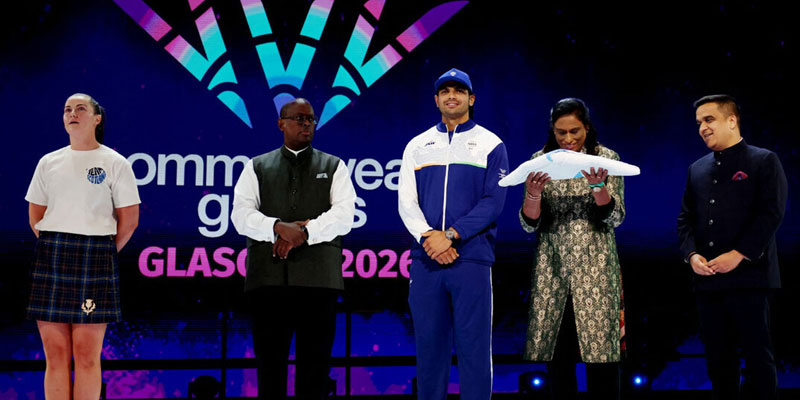
India finished its Commonwealth Games 2026 campaign with 39 medals — 13 gold, 17 silver and 9 bronze, securing fourth place in the overall standings as the curtains came down in Glasgow. The closing ceremony marked more than the end of another successful sporting campaign; it also signalled the beginning of India's next major challenge, with the Commonwealth Games baton officially handed over to Ahmedabad, host of the landmark centenary edition in 2030. The moment reflected India's growing stature in international sport—not only as a competitive nation but also as a future organiser of one of the Commonwealth's biggest sporting spectacles.
A Strong Finish Despite a Reduced Games Programme
India's medal tally may appear modest compared to previous editions, but the context makes the achievement particularly significant. The Glasgow Games featured a reduced competition programme, with several disciplines that have traditionally contributed heavily to India's medal count excluded from the schedule.
Despite these limitations, India demonstrated remarkable resilience and adaptability, finishing behind only Australia, England and Canada. Rather than relying on a handful of events, Indian athletes delivered consistent performances across multiple disciplines, underlining the growing depth of the country's sporting ecosystem.
Balanced Medal Haul Reflects Expanding Sporting Strength
India's campaign was powered by a diversified medal-winning effort.
Boxing emerged as the standout discipline, contributing 10 medals, including an impressive seven gold medals. Athletics matched that tally with another 10 medals, showcasing India's improving standards in track and field.
Weightlifting added eight medals, reaffirming its position as one of India's most dependable medal-producing sports. Judo contributed four medals, highlighting encouraging progress in combat sports, while para-athletics delivered six medals and para-powerlifting added one more, reflecting India's growing investment in inclusive sporting excellence.
The spread of medals across combat, endurance, strength and para-sports indicates that India's sporting success is becoming broader and less dependent on a few traditional disciplines.
Beyond Numbers: What Glasgow 2026 Reveals
Although India's fourth-place finish falls short of its historic 101-medal haul at the 2010 New Delhi Commonwealth Games, direct comparisons are misleading because of the significantly smaller number of events in Glasgow.
More importantly, the Games demonstrated that India remains firmly among the Commonwealth's leading sporting nations despite stronger competition and fewer medal opportunities.
The performance also validates years of sustained investment in athlete development, sports science, coaching infrastructure and grassroots programmes. Disciplines like judo and para-sports have emerged as promising areas for future growth, while boxing and weightlifting continue to anchor India's international success.
Ahmedabad 2030: India's Next Sporting Mission
The ceremonial handover of the Commonwealth baton formally launched Ahmedabad's journey towards hosting the 2030 Commonwealth Games, the centenary edition of the event.
Hosting the Games presents India with an opportunity that extends far beyond medal counts. The country must now deliver world-class infrastructure, efficient logistics, athlete-friendly facilities and flawless event management. It is also an opportunity to showcase India's organisational capabilities on the global sporting stage while building upon the legacy of New Delhi 2010 and addressing the shortcomings experienced during that edition.
The next four years will therefore be as important off the field as on it.
From Glasgow's Success to Ahmedabad's Global Opportunity
India leaves Glasgow with more than just medals—it departs with renewed confidence, broader sporting depth and a clear roadmap for the future. The balanced medal tally reflects the maturity of India's high-performance system, while the baton handover marks the beginning of an even bigger national responsibility. If India can sustain its athlete development programmes and execute Ahmedabad 2030 with excellence, the Glasgow campaign may ultimately be remembered not merely as a successful Commonwealth Games outing, but as the foundation of India's emergence as both a sporting powerhouse and a world-class host nation.
(With agency inputs)