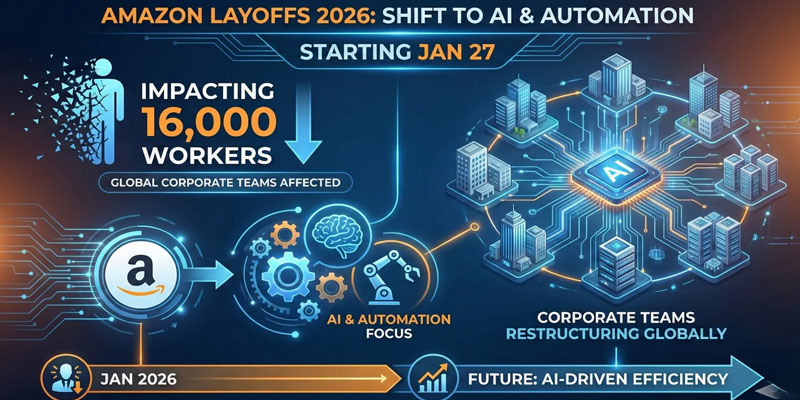
The past 15 days have brought a fresh wave of layoffs across the tech and media industry, with several global giants announcing job cuts almost back-to-back. From Silicon Valley to global media hubs, companies are trimming workforces at an accelerating pace, signaling a deeper structural shift driven by automation, cost pressures, and changing business priorities.
The Numbers: A Rapid Surge in Job Cuts
Major companies have led the charge. Snap Inc. announced around 1,000 layoffs—roughly 16% of its workforce—while Oracle Corporation cut close to 10,000 jobs as part of a broader restructuring plan. Meta Platforms reduced more than 1,500 roles, and The Walt Disney Company continued workforce reductions in its media divisions.
While severance packages vary, companies like Snap and Meta have offered relatively generous exit terms, contrasting with leaner compensation in other firms.
What’s Driving the Layoffs?
Several overlapping factors explain this sudden surge
First, many companies are correcting post-pandemic overhiring. During the digital boom of 2020–2022, firms expanded aggressively, expecting sustained growth that has since slowed.
Second, artificial intelligence is fundamentally reshaping workforce needs. Routine and mid-level roles are increasingly being automated, allowing companies to operate with leaner teams. Nearly 48% of layoffs this year are linked to AI-driven efficiencies, reflecting a “do more with less” approach.
Economic pressures also play a major role. Inflation, global trade tensions, and investor demands for profitability are pushing companies to cut costs. In the media sector, declining advertising revenues have further intensified the need for restructuring.
Strategic Shifts: From Expansion to Efficiency
The layoffs are not merely reactive—they reflect deliberate strategic pivots. Snap is focusing on automation and cost savings, aiming to streamline operations and move toward profitability. Oracle is reallocating resources toward cloud infrastructure and AI-driven data centers, even as it reports strong earnings.
Meanwhile, Disney is restructuring its media business after years of heavy investment in streaming, and Meta continues to double down on artificial intelligence following advances in its Llama models.
Across the board, companies are freezing hiring, exiting non-core businesses, and prioritizing efficiency over expansion. The emphasis has shifted from growth at all costs to sustainable profitability.
Impact on Workforce and Job Market
The human cost of these layoffs is significant. Employees face heightened uncertainty, particularly those in entry-level and mid-tier roles most vulnerable to automation. The job market is increasingly favoring workers with AI, data, and advanced technical skills.
Globally, the effects are rippling beyond the US. India’s IT sector, closely linked to global demand, is also feeling the pressure, with cautious hiring trends and echoes of restructuring.
However, there are some silver linings. Skilled professionals in emerging tech domains may find new opportunities, and leaner organizations could become more financially stable in the long run.
A Structural Reset, not a Temporary Shock
The current wave of layoffs signals more than a cyclical downturn—it marks a structural transformation in how companies operate. As artificial intelligence reshapes industries and economic realities demand efficiency, workforce models are being permanently altered. For businesses, the challenge lies in balancing innovation with responsibility. For workers, the path forward will depend on adaptability and skill evolution. This moment, though disruptive, may ultimately redefine the future of work in a more technology-driven world.
(With agency inputs)