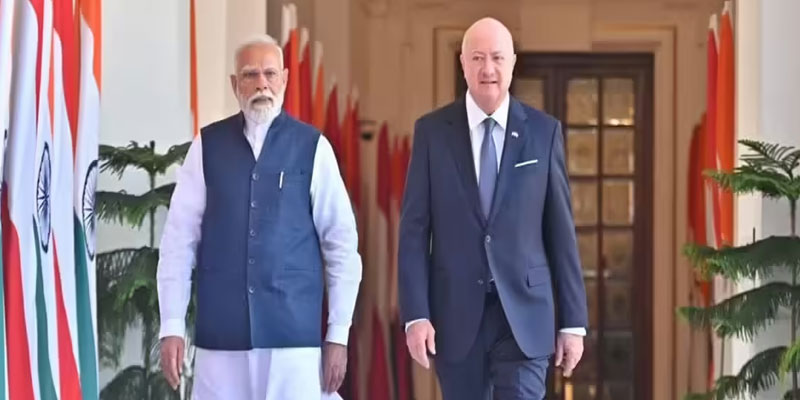
India and Austria on Thursday signed multiple agreements and announcements aimed at deepening bilateral cooperation across defence, trade, technology, education, and culture. The developments came during Austrian Federal Chancellor Christian Stocker’s official visit to New Delhi from April 14–17, 2026—the first such visit by an Austrian Chancellor in over four decades. Hosted by Prime Minister Narendra Modi, the visit marks a significant step in strengthening ties between the two nations.
A Milestone Visit: Reviving a Long-Standing Partnership
The visit is historically significant, coming 42 years after the last Austrian Chancellor’s trip to India in 1983. It reflects renewed momentum in India–Austria relations, which have steadily evolved since diplomatic ties were established in 1954 and upgraded to a strategic partnership in 2016.
Choosing India as his first Asia destination, Chancellor Stocker signaled Austria’s intent to engage more deeply with one of the world’s fastest-growing economies. The bilateral talks at Hyderabad House culminated in 15 outcomes, including Memorandums of Understanding (MoUs) and Letters of Intent (LOIs), under the framework of an “Enhanced Partnership.”
Key Agreements: Expanding the Scope of Cooperation
Among the notable agreements were an MoU on food safety cooperation, an LOI on military matters, and another LOI establishing a Joint Working Group on counter-terrorism. These measures aim to institutionalize collaboration in areas of mutual concern, particularly security and regulatory standards.
Beyond these, both sides agreed to deepen cooperation in infrastructure, renewable energy, semiconductors, and the automotive sector. The agreements also focus on trade facilitation and innovation, reflecting a shared commitment to future-oriented sectors.
A key economic target set during the visit is to increase bilateral trade from the current €3 billion to €5 billion by 2030, alongside encouraging greater investment flows.
Economic Opportunities: Leveraging Complementary Strengths
Austria brings significant industrial expertise to the table, particularly in engineering, advanced manufacturing, and green technologies. Companies specializing in steel, automotive systems, and clean energy solutions are expected to play a larger role in India’s growth story.
For India, the partnership offers access to advanced European technology and investment, supporting initiatives like “Make in India” and production-linked incentive (PLI) schemes. Austrian firms—around 160 already operating in India—employ thousands and are poised to expand further.
At the same time, India’s large market, skilled workforce, and strong growth trajectory make it an attractive destination for Austrian investors seeking diversification.
Strategic and Geopolitical Dimensions
The partnership also carries broader geopolitical significance. As India seeks to strengthen ties with the European Union, Austria can serve as a key gateway, especially in the context of ongoing India–EU free trade agreement negotiations.
Both countries discussed global issues, including the Ukraine conflict, West Asia tensions, and reforms in international institutions like the United Nations and the World Trade Organization. Austria’s neutral foreign policy complements India’s multi-alignment strategy, enabling collaboration without geopolitical constraints.
The establishment of a counter-terrorism working group further highlights shared security concerns and the need for coordinated responses.
Building a Future-Focused Partnership
The India–Austria agreements mark more than a diplomatic milestone—they represent a strategic alignment built on economic opportunity, technological collaboration, and shared global interests. As both nations look to expand trade, investment, and innovation ties, this partnership has the potential to deliver tangible benefits on multiple fronts. For India, it strengthens engagement with Europe; for Austria, it opens doors to a dynamic and rapidly growing market. If sustained, this renewed momentum could transform bilateral ties into a model of modern, mutually beneficial cooperation.
(With agency inputs)