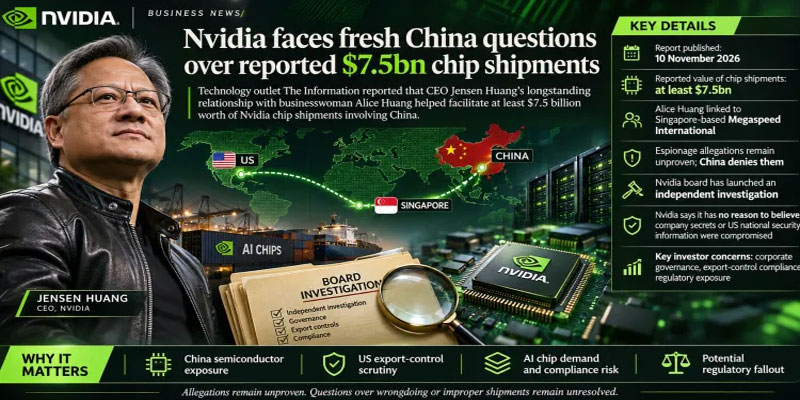
Nvidia is facing fresh scrutiny after a report alleged that at least $7.5 billion worth of its AI chips were channelled into China through a network of connected companies.
According to The Information, the network was linked to Alice Huang, a businesswoman with suspected ties to Chinese intelligence, along with her husband and sister.
The group allegedly set up companies in China and Singapore that moved about 240,000 chips, including H100, H200 and A100 models. Some of those chips were covered by US export controls.
Key Takeaways
- $7.5 billion alleged: a network linked to Alice Huang reportedly moved about 240,000 Nvidia AI chips into China.
- Export controls: some of the chips, including H100 and H200 models, were covered by US restrictions.
- Growing scrutiny: Nvidia’s board is investigating, and the FBI is reportedly looking into whether Huang was targeted.
- Market impact: Nvidia shares fell 4.27%, though analysts still rate the stock a Strong Buy.
- Nothing proven yet: no penalties or financial impact have been established. The key question is whether anyone knowingly broke export rules.
Some of the chips reportedly powered computing for Alibaba, Tencent and smaller Chinese AI developers.
The report claims Alice Huang used her personal relationship with CEO Jensen Huang, and her ties to Nvidia’s distributors, to secure chips when restricted orders ran into obstacles.
One linked firm, Shanghai Century Litong, reportedly gained preferred cloud partner status with Nvidia in October 2023.
Megaspeed, the Singapore company where Alice Huang was an executive, has also faced US scrutiny over chip shipments from Southeast Asia to China. Nvidia has previously called diversion claims “debunked.”
The allegations add to an already difficult moment. Nvidia’s board has launched an independent investigation, and the FBI is reportedly examining whether Huang was targeted by foreign intelligence.
Investors reacted quickly. Nvidia shares fell 4.27% on Monday to close at $178.67, then slipped nearly 1% further in premarket trading.
Importantly, the $7.5 billion is the alleged value of the chips moved, not revenue Nvidia earned from illegal sales. No penalties or financial impact have been established.
The key question is whether investigators find that Nvidia or its distributors knowingly helped get around US export restrictions.
If they did, Nvidia could face fines, tighter export licensing and pressure on its leadership. If not, the episode may expose weak oversight of distributors rather than wrongdoing by the company.
Analysts remain largely bullish. Of 35 ratings issued in the past three months, the consensus is Strong Buy, with an average price target of $327.83, implying about 83% upside.
Still, the risk around governance is rising. For a company at the heart of the US–China technology rivalry, questions about how its chips reach China carry heavy political weight.
Nvidia’s next challenge is not technological. It is proving that its supply chain, and its leadership, can be trusted.