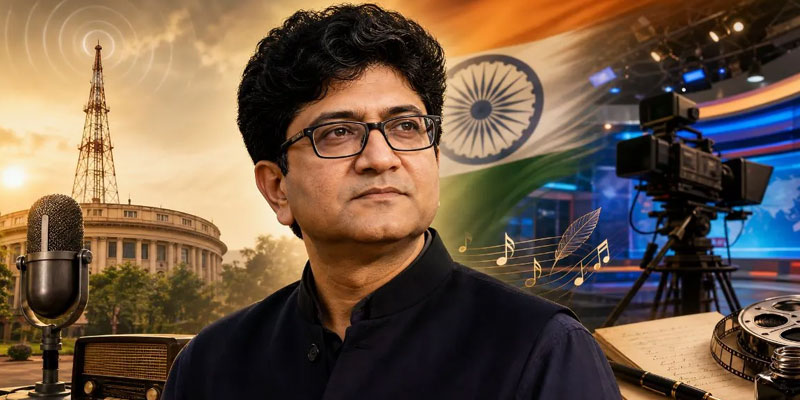
Writer-lyricist and communications expert Prasoon Joshi has long been regarded as one of India’s most influential creative voices, seamlessly blending poetry, storytelling, and mass communication. His appointment as Chairman of Prasar Bharati marks a pivotal moment for India’s public-service media, signalling a renewed emphasis on creativity, cultural depth, and narrative-driven engagement.
A Distinguished Career Across Creative and Communication Domains
Prasoon Joshi’s career spans multiple disciplines—poetry, film lyrics, advertising, and public messaging—making him uniquely positioned at the intersection of art and communication. Known for his evocative lyrics in Hindi cinema and his impactful advertising campaigns, Joshi has built a reputation for capturing India’s cultural ethos in ways that resonate with both urban and rural audiences.
His leadership roles at McCann World group, including CEO for India and Chairman for Asia Pacific, reflect his expertise in large-scale brand storytelling. These experiences have equipped him with a deep understanding of audience engagement, messaging strategies, and the evolving media landscape.
Since 2017, Joshi has also served as Chairperson of the Central Board of Film Certification (CBFC), where he navigated the delicate balance between creative freedom and regulatory oversight. This role further sharpened his ability to manage complex cultural and political sensitivities—an essential skill for leading a public broadcaster.
Prasar Bharati: Mandate and Moment of Transition
Established under the Prasar Bharati Act, 1990 and operational since 1997, Prasar Bharati oversees two of India’s most extensive media networks: Doordarshan and All India Radio. Together, they reach millions across television, radio, and digital platforms, serving as the backbone of public-service broadcasting in India.
Joshi’s appointment comes after a five-month leadership vacuum following the resignation of former chairman Navneet Kumar Sehgal. This transition has reignited discussions about the broadcaster’s autonomy, relevance, and content direction in an era dominated by private channels and streaming platforms.
The government’s decision to appoint a creative professional rather than a traditional bureaucrat reflects a strategic pivot—aimed at transforming Prasar Bharati into a more contemporary and competitive media institution.
Reimagining Public Broadcasting in a Digital Age
Joshi’s background in storytelling and public communication positions him to redefine how Prasar Bharati engages with its audience. His experience in crafting narratives for diverse demographics could help the broadcaster expand its appeal, particularly among younger viewers who increasingly consume content on digital platforms.
There is also an expectation that he will focus on promoting regional languages, folk traditions, and classical arts, aligning with his association with cultural institutions like the Indira Gandhi National Centre for the Arts. Such an approach could strengthen Prasar Bharati’s role as a custodian of India’s cultural heritage while making it more accessible and relevant.
At the same time, Joshi will need to navigate critical issues such as editorial independence, credibility, and the balance between public service and state influence. In a highly polarised media environment, maintaining trust will be as important as enhancing creativity.
A Creative Opportunity with Institutional Responsibility
Prasoon Joshi’s appointment represents both an opportunity and a challenge. His creative vision and communication expertise offer the potential to revitalise Prasar Bharati, transforming it from a legacy broadcaster into a dynamic, narrative-driven platform that reflects contemporary India.
However, success will depend on his ability to integrate innovation with institutional integrity. If he can balance creativity with credible journalism and uphold the broadcaster’s public-service mandate, Joshi could usher in a new era for Indian public media—one that is not only culturally rich but also widely relevant in a rapidly evolving information landscape.
(With agency inputs)