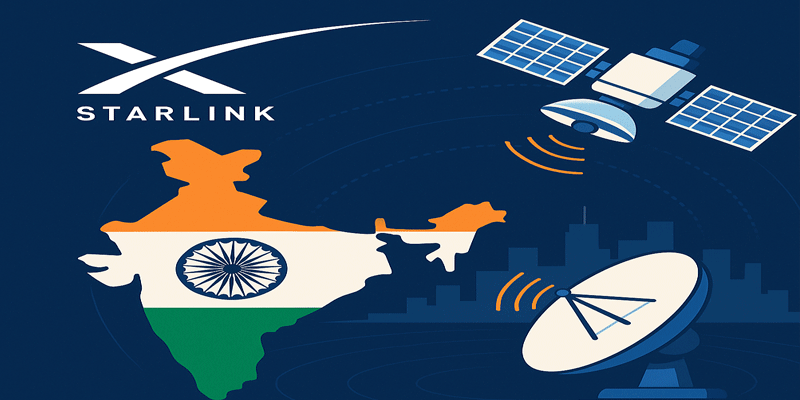
The Centre has rejected Elon Musk’s allegation that “certain oligarchs” are blocking Starlink’s entry into India to preserve a “monopolistic chokehold” over consumers. The Ministry of Communications termed the claim “baseless and misconceived”, maintaining that all licensed satellite-communication providers are undergoing the same regulatory and security scrutiny. The confrontation highlights a growing tension between India’s ambition to expand satellite connectivity and its insistence on stringent controls over critical communications infrastructure.
Starlink’s India Ambition
Starlink has been pursuing entry into India since 2022, seeking to provide high-speed internet through its low-Earth-orbit satellite constellation, particularly in areas where conventional fibre and mobile networks remain difficult or expensive to deploy.
The company received a GMPCS licence from the Department of Telecommunications in June 2025, followed by IN-SPACe authorisation for its first-generation constellation. However, these approvals do not automatically permit commercial operations. Security clearances, spectrum assignment and other operational requirements remain essential.
Musk Alleges a “Monopolistic Chokehold”
Musk made his accusation on X without naming any company or individual. He described the alleged obstruction as a “crime against the people of India”, arguing that regulatory delays were preventing Indian consumers from accessing Starlink's services.
His criticism comes despite Starlink reportedly having made substantial preparations for an Indian launch, including:
· Around 20 gateway sites with hundreds of antennas.
· Systems designed to keep Indian user data within the country.
· Partnerships with Bharti Airtel and Reliance Jio.
· A stated readiness to commence operations once remaining clearances are secured.
The partnerships also complicate the argument that India’s major telecom players are uniformly attempting to keep Starlink out of the market.
Centre Rejects Claims of Selective Treatment
The government maintains that Starlink is not being singled out. According to the Centre, three non-geostationary satellite operators—Starlink, Bharti-backed Eutelsat OneWeb and Reliance Industries-backed Jio Satellite Communications—are undergoing security assessments and are broadly at the same regulatory stage.
The government’s position rests on the sensitive nature of satellite communications. Spectrum, gateways and ground infrastructure can affect:
· Lawful interception and national security.
· Protection and localisation of user data.
· Network security and regulatory oversight.
· Compliance with India's telecommunications framework.
Under the Telecommunications Act, 2023, the government has powers to assign spectrum and impose security conditions on satellite services.
Competition, Spectrum and the Bigger Policy Question
The dispute also comes amid debate over how satellite spectrum should be allocated. TRAI has recommended administrative assignment rather than auctions, with an initial five-year term and possible extension.
For India, satellite broadband could significantly improve connectivity across remote villages, islands, border areas and difficult terrain. But faster approvals must be balanced against security requirements.
India’s Challenge: Speed Without Compromising Security
Musk’s allegation has intensified scrutiny of India’s regulatory process, but it does not identify evidence of any specific “oligarchs” obstructing Starlink. The government’s explanation—that major satellite operators face common security procedures—currently offers the more verifiable account.
The real test, therefore, is not whether India relaxes scrutiny for Starlink, but whether the same rules are applied transparently, consistently and without unnecessary delay. A credible level playing field can attract global satellite investment while protecting national interests—and ultimately give Indian consumers the competition and connectivity they need.
(With agency inputs)