A Nation Shaken by Violence
The killing of conservative activist Charlie Kirk during a debate event at Utah Valley University has reverberated across the United States, sparking bipartisan condemnation and leaving a void in America’s political landscape. Kirk was shot during a Q&A session, later succumbing to his injuries despite emergency surgery. Authorities have described the attack as a suspected political assassination, with the FBI now leading the investigation. The shooter remains at large.
The tragedy unfolded just as tensions in America’s political discourse were already running high, and it has reignited conversations about safety in public life and the dangers facing outspoken figures in a polarized nation.
Trump’s Tribute and Historic Honor
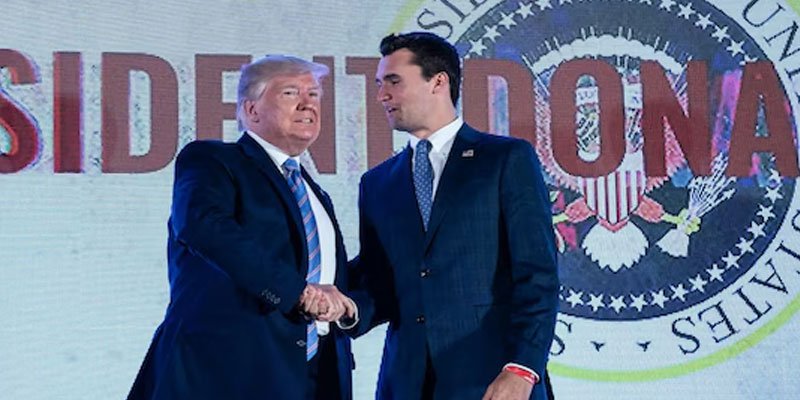
At a solemn moment during the 9/11 memorial services at the Pentagon, President Donald Trump announced that Charlie Kirk would be posthumously awarded the Presidential Medal of Freedom, the nation’s highest civilian recognition. Trump hailed Kirk as “a giant of his generation” and “a champion of liberty,” underscoring his role in shaping conservative youth politics.
In his remarks, Trump added: “We miss him greatly. His voice and courage will live on forever.” He also extended condolences to Kirk’s wife, Erika, and their children, calling them “fantastic people.” Flags across the country were ordered to be flown at half-staff in Kirk’s honor.
Understanding the Medal of Freedom
The Presidential Medal of Freedom, first introduced in 1945 by President Harry Truman and renamed by President John F. Kennedy in 1963, is awarded to individuals who make extraordinary contributions to society. It has been conferred on figures as varied as Martin Luther King Jr., Neil Armstrong, Ella Fitzgerald, and Maya Angelou.
The medal carries two distinctions: the standard honor and the rare “with distinction” level, reserved for those whose impact is deemed exceptional. Its symbolism—a white star on a red pentagon, circled by golden eagles and capped with 13 stars—reflects the ideals of unity and service to the nation.
Kirk’s inclusion in this legacy marks him among leaders, thinkers, and visionaries recognized for reshaping American life and culture.
Kirk’s Work and Popularity
Charlie Kirk, who founded Turning Point USA (TPUSA) in 2012, quickly rose to prominence as a voice for young conservatives. The non-profit organization, headquartered in Phoenix, Arizona, became a major platform for student engagement on college campuses nationwide. Known for his sharp debating style, prolific social media presence, and relentless advocacy for free speech, Kirk built a loyal following among millions of young Americans.
Supporters saw him as an articulate defender of traditional values and market-based policies, while critics viewed him as a polarizing figure. Regardless of political leanings, his ability to mobilize and inspire youth was undeniable, making him one of the most visible activists of his generation.
A Legacy Beyond Politics
Kirk’s death has drawn sympathy across the political spectrum, with many lawmakers emphasizing that violence must never replace dialogue in a democratic society. While his positions often provoked controversy, his commitment to engaging with students, fostering debate, and amplifying conservative perspectives made him a significant figure in modern American politics.
Honoring a Controversial but Influential Voice
The decision to honor Charlie Kirk with the Presidential Medal of Freedom highlights not just his political advocacy but also the impact of his efforts to shape youth engagement in American democracy. His killing is a reminder of the fragile state of public discourse and the urgent need to safeguard free expression, regardless of ideological differences.
Kirk’s supporters will remember him as a fearless activist, his critics as a divisive voice—but his legacy will remain part of the nation’s broader story of political activism. The medal ensures his name will be etched alongside those who profoundly influenced American society, even as the nation reflects on how to prevent such tragedies from dimming voices in its democratic space.
(With agency inputs)