A Global Pause at the Final Immigration Gateway
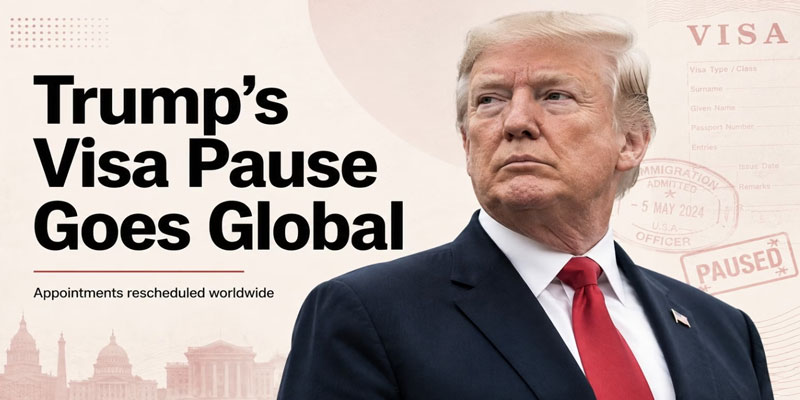
The Trump administration’s decision to pause immigrant-visa appointments worldwide has introduced fresh uncertainty for people seeking permanent entry into the United States. The State Department says consular officers are undergoing training on “public charge” screening, aimed at ensuring applications are assessed consistently. Importantly, the development concerns immigrant-visa interviews, rather than a confirmed blanket suspension of visitor, student or temporary-work visas.
Why Washington Has Paused Appointments
The State Department announced on August 25 that training had begun across US embassies and consulates. Officers are being instructed to assess applicants comprehensively and determine whether prospective immigrants could become dependent on public benefits. The department has not specified how long the training will last, leaving affected posts to reschedule appointments without a uniform timetable for restarting them.
The move comes amid a broader Trump administration effort to tighten both legal and irregular immigration. The State Department says more than 175,000 visas have been revoked during President Donald Trump’s current term. It has also announced plans targeting B-1/B-2 visitor visas held by people who have sought asylum.
The latest pause therefore matters not simply as an administrative exercise, but because it could signal tougher scrutiny of applicants seeking permanent residence.
What “Public Charge” Screening Means
Under US immigration law, a person can be considered inadmissible if a consular officer determines that they are likely to become a public charge. The assessment is prospective rather than based simply on whether someone has previously received government assistance.
Officers can consider factors including age, health, family circumstances, financial resources, assets, education and skills. Such a broad assessment gives consular officials significant discretion, making consistent standards and clear documentation especially important.
Supporters of tougher screening argue that it protects public resources and strengthens the integrity of the immigration system. Critics, however, warn that greater scrutiny could increase paperwork, delay family reunification and create uncertainty for applicants whose financial or medical circumstances are difficult to assess objectively.
Delays Could Have Real-World Consequences
The pause comes at a particularly sensitive point for applicants who have already completed much of the immigration process. Spouses, children, parents, employment-based applicants and diversity-visa beneficiaries may face delays after months or years of preparation.
Extended postponements could cause medical examinations or police certificates to expire, disrupt employment plans and prolong family separation. For applicants in time-limited visa categories, delays could carry consequences beyond inconvenience.
The legal environment also makes the administration’s approach significant. On August 22, a federal judge struck down a separate policy suspending immigrant-visa processing for applicants from 75 countries. That ruling could become relevant if temporary training increasingly functions as an indefinite or selective barrier to visa processing.
Training Must Not Become an Invisible Immigration Barrier
The central challenge for Washington is balancing stronger screening with predictable administration. Training consular officers is a legitimate management function, but applicants also require transparency about timelines, documentation and rescheduling.
For those affected, the prudent course is to follow official embassy instructions, maintain updated financial and supporting documents, and avoid irreversible travel or employment commitments until interviews are reconfirmed.
Ultimately, immigration enforcement gains legitimacy when rules are firm but procedures remain transparent. If the current pause is genuinely temporary and designed to improve consistency, it may strengthen the system. If uncertainty becomes prolonged, however, it risks turning an administrative exercise into an opaque barrier to lawful immigration.
(With agency inputs)