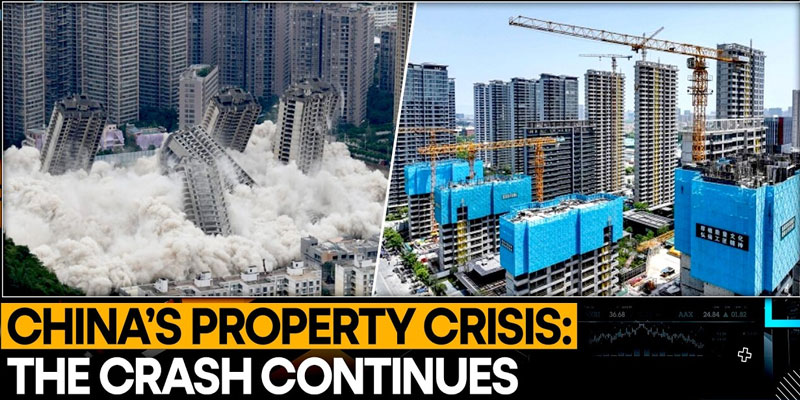
Evergrande’s Founder Sentenced, But Crisis Persists
China’s property crisis has outlived its most recognisable corporate casualty. The life sentence handed to Evergrande founder Hui Ka Yan marks a dramatic personal reckoning, but does little to resolve the deeper problems of excess housing, heavily indebted developers, falling land revenues and cautious consumers. The episode underlines a difficult reality: China may have punished one of the property boom’s most prominent figures, but it has yet to repair the economic model that produced the crisis.
Evergrande Becomes a Symbol of Excess
A Shenzhen court sentenced Hui to life imprisonment on August 20 after he pleaded guilty to eight charges, including fundraising fraud, misuse of funds, illegal public-deposit taking, fraudulent securities issuance and bribery. His personal assets were also confiscated.
Evergrande’s collapse exposed the vulnerabilities of China’s debt-fuelled property model. Developers borrowed aggressively, acquired land, sold homes before completion and depended on rising prices and continuous sales to sustain the cycle. When Beijing tightened credit, the model unravelled, leaving defaults, unfinished apartments and enormous debts behind.
Hui’s conviction may reinforce accountability, but it cannot itself complete abandoned projects, restore confidence or create demand for surplus housing.
Property Market Still Searching for a Bottom
Six years after Beijing began restricting excessive developer borrowing, the downturn remains widespread. New-home prices in 70 major cities fell 0.1% month-on-month in July, matching June’s decline, while prices were down 3.2% year-on-year.
The broader indicators are more troubling. During January-July 2026, nationwide sales of new commercial property declined 11.8% by floor area and 13.1% by value. Property investment fell 19.2%, while new construction starts dropped about 24%.
Even relatively resilient cities such as Beijing and Shanghai offer limited comfort. Weaker second- and third-tier cities continue to face larger inventories and softer demand. Land sales across 300 cities fell 22.7% by area during the first seven months, further squeezing local governments that traditionally relied heavily on land revenue.
Falling Prices Are Also a Confidence Crisis
China’s housing problem is fundamentally a balance-sheet crisis. Property represents a major component of household wealth. Falling prices therefore encourage families to save rather than spend and make prospective buyers hesitant to purchase homes that could lose further value.
The unfinished-home problem has compounded the damage. The pre-sale system left millions of buyers exposed when developers ran out of funds, weakening trust in purchasing apartments before completion. Government measures to ensure project delivery and stimulate housing demand have provided support, but have yet to generate a self-sustaining recovery.
Analysts remain divided over how long the adjustment could take, highlighting the uncertainty surrounding the eventual market equilibrium.
China’s New Growth Model Faces Its Own Test
Beijing is increasingly redirecting investment towards semiconductors, electric vehicles, batteries, artificial intelligence and advanced manufacturing. The strategy aims to replace property-led expansion with technology-driven growth and greater industrial self-reliance.
But manufacturing cannot quickly replace real estate’s contribution to employment, household wealth, construction activity and local-government finances. Excess industrial capacity is also pushing Chinese companies towards overseas markets, increasing trade tensions.
The Crisis Is Now About China’s Economic Transition
Evergrande’s collapse and Hui Ka Yan’s sentencing represent the end of an era, but not necessarily the end of its consequences. China’s central challenge is no longer rescuing individual developers; it is rebuilding household confidence while shifting the economy from property-led expansion to sustainable consumption, technology and manufacturing.
Until that transition generates stronger domestic demand and a credible solution for housing inventories and unfinished homes, China’s property crisis will remain a drag on growth—long after Evergrande itself has disappeared from the headlines.
(With agency inputs)