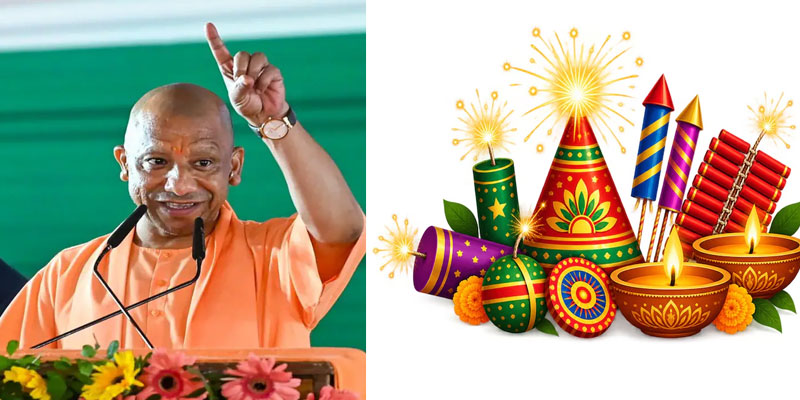
Uttar Pradesh Chief Minister Yogi Adityanath has defended bursting firecrackers during Diwali, asserting that his government imposed no restrictions on celebrations and that any pollution generated would eventually dissipate. His remarks have reignited the debate over cultural and religious freedom, environmental responsibility and public health, particularly after Delhi and the National Capital Region (NCR) experienced a sharp deterioration in air quality following Diwali celebrations.
Yogi Adityanath's Defence of Diwali Celebrations
He argued that while fireworks were being criticised for causing temporary pollution, other issues such as corruption, which he described as having polluted the entire system, received comparatively less attention.
The Chief Minister maintained that pollution resulting from festival celebrations would eventually subside. His position reflects opposition to a blanket prohibition on firecrackers and emphasises the freedom of people to celebrate an important cultural and religious occasion.
Delhi Records Severe Air Pollution
The controversy intensified after Delhi's air quality deteriorated dramatically following Diwali.
Of the capital's 51 monitoring stations, 14 recorded severe air quality, while most of the remaining stations reported very poor conditions.
Private monitoring platform IQAir reported readings exceeding 1,000 in locations including Shahdara and Defence Colony. However, differences in monitoring methodologies, averaging periods and measurement scales explain why these figures differ from the CPCB's official AQI, which is capped at 500.
Why Firecracker Pollution Raises Health Concerns
Firecrackers release particulate matter, sulphur dioxide, nitrogen oxides and potentially harmful metals into the atmosphere.
Their impact becomes particularly concerning during winter, when several pollution sources combine:
· Vehicular emissions and industrial pollutants.
· Construction dust and road dust.
· Crop-residue burning in neighbouring states.
· Low wind speeds and atmospheric temperature inversion.
· Additional particulate emissions from fireworks.
Children, elderly people and individuals suffering from respiratory or cardiovascular conditions face heightened health risks during severe pollution episodes.
Cultural Freedom Versus Environmental Responsibility
While unrestricted fireworks can aggravate pollution, blanket prohibitions also face implementation difficulties and resistance. Alternatives include allowing certified green crackers, regulating sale and distribution, restricting bursting hours and strengthening pollution monitoring.
Finding Common Ground Between Tradition and Public Health
The immediate question is whether Diwali-related pollution dissipates quickly or compounds the already deteriorating winter air quality. Governments must recognise that cultural celebrations and environmental protection need not be mutually exclusive. A practical approach requires scientific monitoring, consistent enforcement, public awareness and proportionate restrictions. Ultimately, preserving the spirit of Diwali while protecting citizens' right to breathe clean air demands a balanced, evidence-based policy rather than an increasingly polarised annual confrontation.
(With agency inputs)