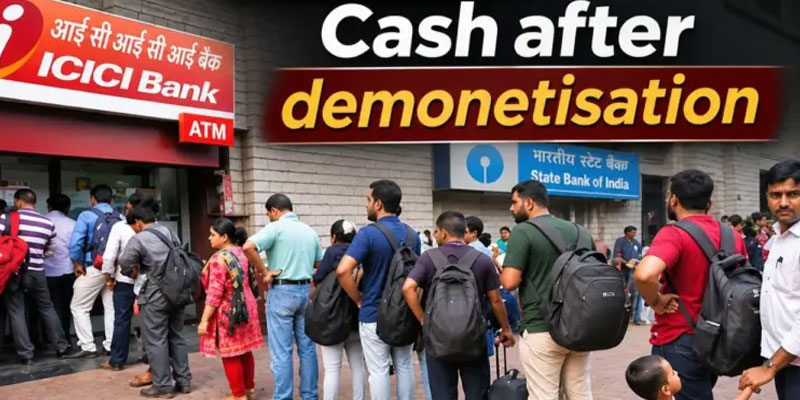
India's Cash Economy Endures
Ten years after demonetisation, India's digital-payments revolution and dependence on physical currency have continued to grow side by side. Despite the extraordinary expansion of the Unified Payments Interface (UPI), cash remains deeply embedded in everyday economic activity. Reserve Bank of India (RBI) data reveal that currency with the public has more than doubled since November 2016, demonstrating that digital payments have expanded the financial ecosystem without replacing traditional cash transactions.
What Do RBI's Cash Figures Reveal?
On November 4, 2016, immediately before the withdrawal of ₹500 and ₹1,000 banknotes, India's currency in circulation stood at ₹17.97 lakh crore. By October 15, 2026, it had climbed to ₹42.55 lakh crore, representing an increase of approximately 136.8%, or 2.37 times the pre-demonetisation level.
The RBI's 2025-26 Annual Report further highlights the continuing demand for physical currency:
· Banknote value in circulation increased 11.9% during FY26.
· Banknote volume grew 10.5%.
· Currency in circulation reached approximately ₹41.68 lakh crore by March 2026.
These figures indicate that cash demand continues to expand despite widespread digital-payment adoption.
Cash-To-GDP Ratio: A Significant Indicator
Currency in circulation as a proportion of GDP provides a clearer picture of cash dependence. This ratio stood at 11.9% in 2015-16, before demonetisation. Following an initial decline, it increased to 14.4% during the pandemic in 2020-21 and subsequently moderated to 12.1% in 2025-26.
The return to approximately pre-demonetisation levels indicates that India's overall cash intensity has not undergone a lasting decline.
UPI Revolution Has Transformed Payments
Digitalisation, nevertheless, has achieved remarkable progress. During FY26, UPI processed approximately 241.6 billion transactions worth ₹314.2 trillion. Its transaction value reached nearly 91% of GDP, compared with negligible levels in 2016-17.
However, UPI primarily facilitates frequent, relatively small-value transactions, while cash continues to serve merchants, informal workers and consumers requiring immediate liquidity.
Why Does India Still Depend on Cash?
Several factors explain the persistence of physical currency:
· Rural transactions and areas with unreliable internet connectivity.
· Informal-sector wages and small-business payments.
· Emergency requirements, privacy and precautionary savings.
· Religious, social and household expenditure.
Interestingly, ₹500 notes accounted for approximately 85.5% of banknotes by value at March 2026. Inflation and economic expansion also increase the absolute demand for currency.
Demonetisation: What Changed and What Did Not?
The evidence suggests that demonetisation failed to achieve a sustained reduction in cash circulation. Its more enduring legacy was accelerating digital-payment infrastructure, particularly UPI.
India's Future Is Cash-Plus-Digital, Not Cashless
India's experience demonstrates that technological transformation does not necessarily eliminate established financial habits. With ₹42.55 lakh crore in currency with the public, cash remains indispensable even as digital transactions reshape commerce. The real achievement is the emergence of a dual-payment economy where digital convenience and physical money coexist, expanding financial choices rather than forcing an artificial transition towards a completely cashless society.
(With agency inputs)