

A Strategic Signal Beneath the Seas
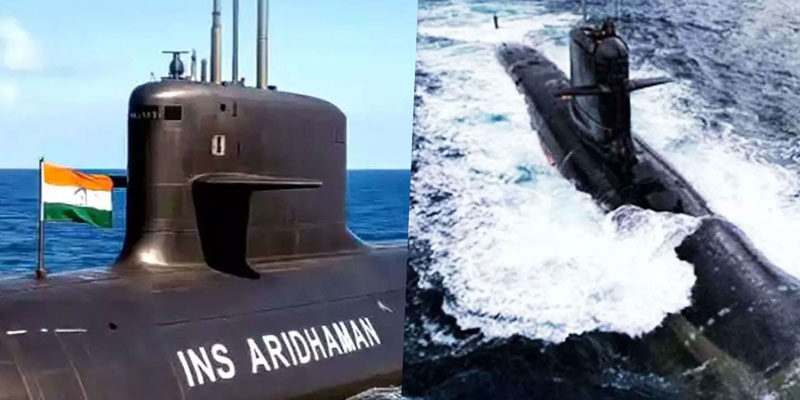
India appears set to commission its third nuclear-powered ballistic missile submarine, INS Aridhaman, with Defence Minister Rajnath Singh hinting at its imminent induction. The move marks a significant milestone in India’s quest to strengthen its nuclear triad—land, air, and sea-based delivery systems. As Aridhaman prepares to join the Strategic Forces Command, it represents not just an addition to the fleet, but a qualitative leap in India’s second-strike capability and long-term deterrence posture.
Built for Stealth and Endurance
INS Aridhaman, developed under the Advanced Technology Vessel (ATV) programme at Visakhapatnam, is an upgraded Arihant-class submarine with a displacement of around 7,000 tonnes—larger than its predecessors. At its core lies an 83 MW Compact Light Water Reactor, enabling extended underwater endurance and minimal acoustic signature.
This low-noise profile is critical. In nuclear deterrence, survivability is everything, and stealth ensures that the submarine remains undetected during patrols. Its propulsion system allows speeds of up to 24 knots when submerged, combining silent endurance with the ability to reposition quickly if required. These features make Aridhaman a formidable platform designed for long-duration, covert deployments in the Indian Ocean.
Expanded Firepower and Missile Flexibility
One of Aridhaman’s most notable advancements is its missile capacity. Unlike earlier Arihant-class submarines that carried four vertical launch tubes, Aridhaman is equipped with eight. This effectively doubles its payload flexibility and enhances mission adaptability.
The submarine can deploy a mix of submarine-launched ballistic missiles, including the short-range K-15 Sagarika, the intermediate-range K-4, and potentially the long-range K-5 missiles with a reach of up to 6,000 km. This layered missile capability allows India to hold strategic targets at risk across vast distances—from regional adversaries to deeper continental zones—while remaining safely within its maritime bastions.
Such capability reinforces India’s doctrine of “assured retaliation,” ensuring that even in the event of a first strike, a credible and devastating response remains guaranteed.
Strengthening the Nuclear Triad
Aridhaman’s induction significantly enhances the sea-based leg of India’s nuclear triad, widely considered the most survivable component. Operating from Visakhapatnam alongside other nuclear and conventional submarines, it will contribute to a layered undersea deterrent architecture.
Crucially, its longer-range missile systems reduce the need for forward deployment into contested waters, lowering operational risks while maintaining strike credibility. This aligns with India’s stated “no-first-use” policy, where deterrence is built not on aggression but on the certainty of retaliation.
Strategic Implications in a Volatile Region
The arrival of Aridhaman signals India’s growing technological maturity in undersea warfare and strategic deterrence. It places India closer to established nuclear powers in terms of sea-based capabilities, potentially altering regional security calculations.
At the same time, such advancements may encourage caution among adversaries, reinforcing stability through deterrence. By investing in survivable second-strike assets rather than offensive posturing, India continues to emphasise restraint while ensuring preparedness in an increasingly contested Indo-Pacific.
Power Through Silence
INS Aridhaman embodies a quiet but profound shift in India’s strategic posture—one that prioritises survivability, credibility, and technological self-reliance. As it prepares to join active service, it strengthens not just India’s naval capabilities but its overall deterrence framework. In the opaque world of nuclear strategy, where visibility can be vulnerability, Aridhaman’s true power lies in its silence—ensuring peace through the assurance of an unseen, unstoppable response.
(With agency inputs)