India Expands Pacific Healthcare Reach with Sea Ambulances
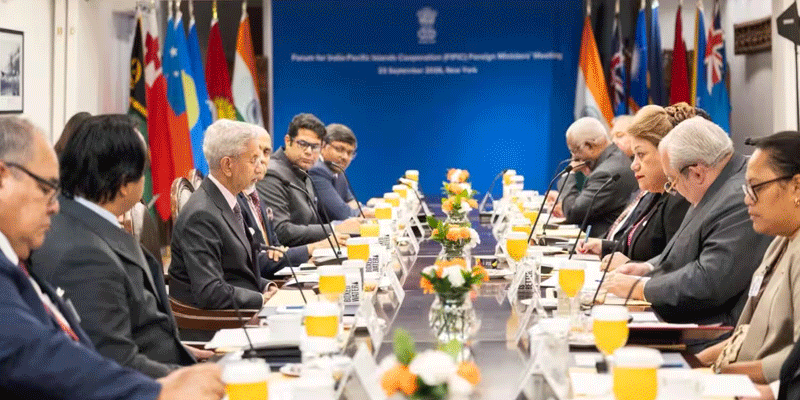
India will provide 20 sea ambulances to Pacific Island countries by March 2027, External Affairs Minister S. Jaishankar announced at the India–Fiji–Pacific Islands Cooperation (FIPIC) Foreign Ministers’ meeting in New York. Requested by 12 Pacific Island states, the vessels are already under procurement, placing emergency healthcare and connectivity at the centre of India’s expanding development partnership with the region.
Why Sea Ambulances Matter in the Pacific
For many Pacific nations, geography itself is a healthcare challenge. Communities are spread across distant islands, often separated from specialist hospitals by hundreds of kilometres of ocean.
Sea ambulances can bridge that gap by enabling:
· Emergency patient evacuation and inter-island referrals.
· Maternal and emergency medical transport.
· Faster access to specialist treatment.
· Medical assistance during natural disasters and other emergencies.
However, the vessels alone will not guarantee better healthcare. Their effectiveness will depend on trained crews, maintenance, fuel availability, docking facilities and coordination between island administrations and hospitals.
Fiji Hospital Could Become Regional Hub
The sea-ambulance initiative complements India’s support for a 100-bed super-specialty hospital in Fiji. The project, announced at the 2023 FIPIC Summit, is intended to strengthen advanced healthcare capacity and serve as a regional medical resource. Fiji has described the hospital as a landmark component of its partnership with India.
The hospital could eventually reduce the need for patients from smaller Pacific nations to travel long distances for specialised treatment. Its wider value will depend on staffing, affordability, operational readiness and reliable connections with remote islands. The project is currently advancing through procurement and tendering processes.
A Wider Development Partnership
India’s Pacific engagement extends well beyond healthcare. At the FIPIC meeting, Jaishankar highlighted progress in renewable energy, digital capacity, disaster resilience, space cooperation, ocean research and training.
India has already solarised 2,800 households across 14 Pacific Island countries and trained 70 women solar engineers. An artificial-limb fitment camp planned in Fiji is expected to assist around 650 patients. India is also supporting healthcare equipment, including haemodialysis machines, across several island nations.
Jaishankar also proposed customised training programmes based on individual countries’ priorities, reinforcing what New Delhi describes as a demand-driven and people-centric development model.
Healthcare Diplomacy with Strategic Significance
India’s growing Pacific engagement has an important strategic dimension. The region is increasingly significant amid wider competition involving China, the United States, Australia and other external powers. By focusing on healthcare, renewable energy, disaster resilience and capacity building, New Delhi is building relationships through practical public goods rather than security commitments alone.
India’s inclusion in the strategic partner stream of the Pacific Islands Forum, the region’s principal political grouping, adds institutional weight to this engagement.
From Promises to Lasting Pacific Partnerships
The 20 sea ambulances are therefore more than medical vessels. They represent an attempt to address one of the Pacific’s most difficult structural challenges—distance.
Their real test will come after delivery: whether they remain operational, whether local personnel are trained to use them and whether they are integrated with hospitals and emergency systems. If India can connect the sea ambulances with Fiji’s emerging specialist healthcare infrastructure and wider regional networks, the initiative could turn a highly practical humanitarian programme into a durable foundation for India’s Pacific partnership.
(With agency inputs)