The Pradhan Mantri Jan Dhan Yojana (PMJDY) – the National Mission for Financial Inclusion - completes nine years of successful implementation today.
The PMJDY was announced by Prime Minister Shri Narendra Modi in his Independence Day address on 15th August 2014. While launching the programme on 28th August 2014, the Prime Minister had described the occasion as a festival to celebrate the liberation of the poor from a vicious cycle.
 a
Being one of the biggest financial inclusion initiatives in the world, the Ministry of Finance continuously endeavours to provide financial inclusiveness and support to the marginalised and economically backward sections through its financial inclusion led interventions. Financial Inclusion (FI) promotes equitable and inclusive growth as well as delivery of financial services at an affordable cost to vulnerable groups such as low-income groups and weaker sections that lack access to basic banking services.
Financial Inclusion also brings savings of the poor into the formal financial system and provides an avenue to remit money to their families in villages besides taking them out of the clutches of the usurious money lenders.
On the 9th anniversary of PMJDY, Union Finance Minister Smt. Nirmala Sitharaman, in her message said, “The 9 years of PMJDY-led interventions and digital transformation have revolutionised financial inclusion in India. It is heartening to note that more than 50 crore people have been brought into the formal banking system through the opening of Jan Dhan Accounts. Among these accounts, approximately 55.5% belong to women, and 67% have been opened in Rural / Semi-Urban areas. The cumulative deposits in these accounts surpass ₹2 lakh crore. Furthermore, about 34 crore RuPay cards have been issued to these accounts without charge, which also provides for a ₹2 lakh accident insurance cover.”
“With the collaborative efforts of stakeholders, banks, insurance companies, and government officials, the PMJDY stands out as a pivotal initiative, changing the landscape of financial inclusion in the country as envisioned by Hon’ble Prime Minister Shri Narendra Modi,” Smt. Sitharaman said.
Union Minister of State for Finance Dr. Bhagwat Kisanrao Karad also expressed his thoughts for PMJDY on this occasion. He said, “PMJDY scheme has reduced financial untouchability by bringing the marginalised sections of the society into the ambit of formal banking. By providing access to banking facilities to vulnerable sections of the society, facilitating access to availability of credit, providing insurance and pension coverage and creating financial awareness, the outcomes of the scheme are far reaching and have a multiplier effect on the economy. Further, Jan Dhan–Aadhaar–Mobile (JAM) architecture has enabled successful transfer of Government benefits in the accounts of common man seamlessly. PMJDY accounts have become fulcrum of people-centric initiatives like DBT and has contributed towards inclusive growth of all sections of the society, especially the underprivileged.”
As we complete 9 years of successful implementation of this Scheme, we take a look at the major aspects and achievements of this Scheme so far.
Background
Pradhan Mantri Jan Dhan Yojana (PMJDY) is National Mission for Financial Inclusion to ensure access to financial services, namely, Banking/ Savings & Deposit Accounts, Remittance, Credit, Insurance, Pension in an affordable manner.
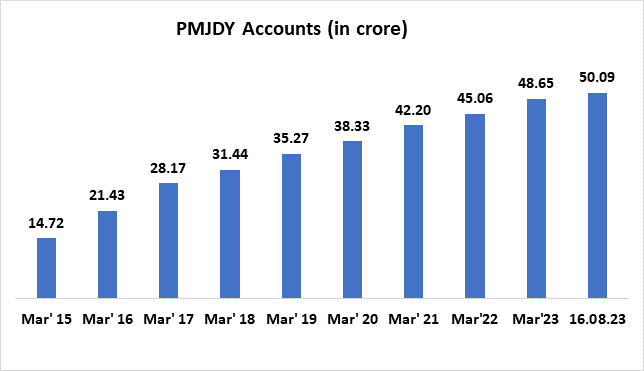 As on 9th August 23 number of total PMJDY Accounts: 50.09 crore; 55.6% (27.82 crore) Jan-Dhan account holders are women and 66.7% (33.45 crore) Jan Dhan accounts are in rural and semi-urban areas
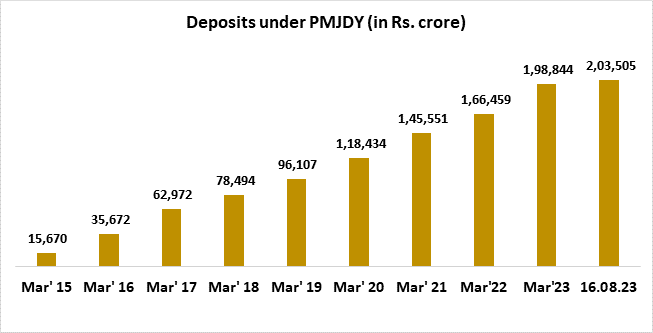 Total deposit balances under PMJDY Accounts stand at Rs. 2,03,505 crore
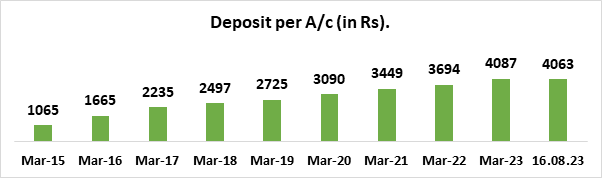 Average deposit per account is Rs. 4,063 as on 16.08.2023
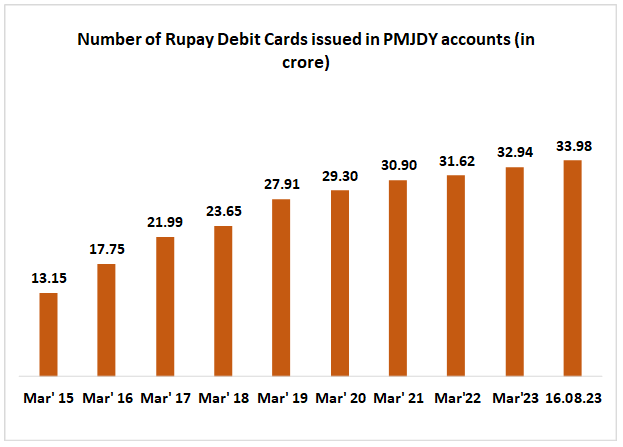 Total RuPay cards issued to PMJDY accountholders: 33.98 crore
a
Being one of the biggest financial inclusion initiatives in the world, the Ministry of Finance continuously endeavours to provide financial inclusiveness and support to the marginalised and economically backward sections through its financial inclusion led interventions. Financial Inclusion (FI) promotes equitable and inclusive growth as well as delivery of financial services at an affordable cost to vulnerable groups such as low-income groups and weaker sections that lack access to basic banking services.
Financial Inclusion also brings savings of the poor into the formal financial system and provides an avenue to remit money to their families in villages besides taking them out of the clutches of the usurious money lenders.
On the 9th anniversary of PMJDY, Union Finance Minister Smt. Nirmala Sitharaman, in her message said, “The 9 years of PMJDY-led interventions and digital transformation have revolutionised financial inclusion in India. It is heartening to note that more than 50 crore people have been brought into the formal banking system through the opening of Jan Dhan Accounts. Among these accounts, approximately 55.5% belong to women, and 67% have been opened in Rural / Semi-Urban areas. The cumulative deposits in these accounts surpass ₹2 lakh crore. Furthermore, about 34 crore RuPay cards have been issued to these accounts without charge, which also provides for a ₹2 lakh accident insurance cover.”
“With the collaborative efforts of stakeholders, banks, insurance companies, and government officials, the PMJDY stands out as a pivotal initiative, changing the landscape of financial inclusion in the country as envisioned by Hon’ble Prime Minister Shri Narendra Modi,” Smt. Sitharaman said.
Union Minister of State for Finance Dr. Bhagwat Kisanrao Karad also expressed his thoughts for PMJDY on this occasion. He said, “PMJDY scheme has reduced financial untouchability by bringing the marginalised sections of the society into the ambit of formal banking. By providing access to banking facilities to vulnerable sections of the society, facilitating access to availability of credit, providing insurance and pension coverage and creating financial awareness, the outcomes of the scheme are far reaching and have a multiplier effect on the economy. Further, Jan Dhan–Aadhaar–Mobile (JAM) architecture has enabled successful transfer of Government benefits in the accounts of common man seamlessly. PMJDY accounts have become fulcrum of people-centric initiatives like DBT and has contributed towards inclusive growth of all sections of the society, especially the underprivileged.”
As we complete 9 years of successful implementation of this Scheme, we take a look at the major aspects and achievements of this Scheme so far.
Background
Pradhan Mantri Jan Dhan Yojana (PMJDY) is National Mission for Financial Inclusion to ensure access to financial services, namely, Banking/ Savings & Deposit Accounts, Remittance, Credit, Insurance, Pension in an affordable manner.
- Objectives:
- Ensure access of financial products & services at an affordable cost
- Use of technology to lower cost & widen reach
- Basic tenets of the scheme
- Banking the unbanked - Opening of basic savings bank deposit (BSBD) account with minimal paperwork, relaxed KYC, e-KYC, account opening in camp mode, zero balance & zero charges
- Securing the unsecured - Issuance of Indigenous Debit cards for cash withdrawals & payments at merchant locations, with free accident insurance coverage of Rs. 2 lakhs
- Funding the unfunded - Other financial products like micro-insurance, overdraft for consumption, micro-pension & micro-credit
- Initial Features of PMJDY
- Basic savings bank accounts with overdraft facility of Rs. 10,000/- to every eligible adult
- Financial Literacy Programme– Promoting savings, use of ATMs, getting ready for credit, availing insurance and pensions, using basic mobile phones for banking
- Creation of Credit Guarantee Fund – To provide banks some guarantee against defaults
- Insurance – Accident cover up to Rs. 1,00,000 and life cover of Rs. 30,000 on account opened between 15 Aug 2014 to 31 January 2015
- Pension scheme for Unorganised sector
- Important approach adopted in PMJDY based on experience:
-
- Inter-operability through RuPay debit card or Aadhaar enabled Payment System (AePS)
- Fixed-point Business Correspondents
- Simplified KYC / e-KYC in place of cumbersome KYC formalities
- Extension of PMJDY with New features – The Government decided to extend the comprehensive PMJDY programme beyond 28.8.2018 with some modifications
- Focus shifted from ‘Every Household’ to Every Unbanked Adult’
- RuPay Card Insurance - Free accidental insurance cover on RuPay cards increased from Rs. 1 lakh to Rs. 2 lakhs for PMJDY accounts opened after 28.8.2018.
- Enhancement in overdraft facilities: OD limit doubled from Rs 5,000/- to Rs 10,000/-; OD upto Rs 2,000/- (without conditions) with Increase in upper age limit for OD from 60 to 65 years
- Impact of PMJDY
- Achievements under PMJDY- As on 16th August’23:
- PMJDY Accounts
As on 9th August 23 number of total PMJDY Accounts: 50.09 crore; 55.6% (27.82 crore) Jan-Dhan account holders are women and 66.7% (33.45 crore) Jan Dhan accounts are in rural and semi-urban areas
- During first year of scheme 17.90 crore PMJDY accounts were opened
- Continuous increase in no of accounts under PMJDY
- PMJDY Accounts have grown three-fold (3.4) from 14.72 crore in March 15 to 50.09 crore as on 16-08-2023. Undoubtedly a remarkable journey for the Financial Inclusion Programme.
Total deposit balances under PMJDY Accounts stand at Rs. 2,03,505 crore
- Deposits have increased about 13 times with increase in accounts 3.34 times (Aug’23 / Aug’15)
Average deposit per account is Rs. 4,063 as on 16.08.2023
- Avg. Deposit per account has increased over 3.8 times over August 15
- Increase in average deposit is another indication of increased usage of accounts and inculcation of saving habit among account holders
- RuPay Card issued to PMJDY account holders
Total RuPay cards issued to PMJDY accountholders: 33.98 crore
- Number of RuPay cards & their usage has increased over time
- Jan Dhan Darshak App (JDD App)
- Towards ensuring smooth DBT transactions
- Digital transactions: With the issue of over 33.98 crore RuPay debit cards under PMJDY, installation of 79.61 lakh PoS/mPoS machines and the introduction of mobile based payment systems like UPI, the total number of digital transactions have gone up from 1,471 crore in FY 17-18 to 11,394 crore in FY 22-23. The total number of UPI financial transactions have increased from 92 crore in FY 2017-18 to 8,371 crore in FY 2022-23. Similarly, total number of RuPay card transactions at PoS & e-commerce have increased from 67 crore in FY 2017-18 to 126 crore in FY 2022-23.
- Endeavour to ensure coverage of PMJDY account holders under micro insurance schemes. Eligible PMJDY accountholders will be sought to be covered under PMJJBY and PMSBY. Banks have already been communicated about the same.
- Promotion of digital payments including RuPay debit card usage amongst PMJDY accountholders through creation of acceptance infrastructure across India
- Improving access of PMJDY account holders to Micro-credit and micro investment such as flexi-recurring deposit etc.