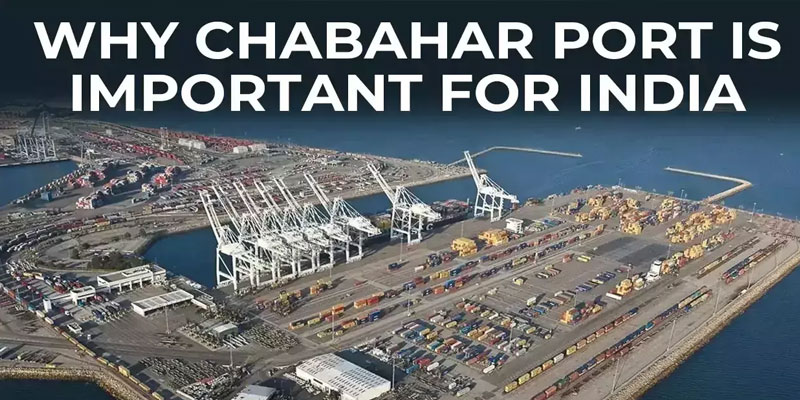
India’s decade-long investment in the strategically significant Chabahar Port has come under fresh uncertainty after reported US airstrikes damaged infrastructure near the Iranian port. While there is no confirmation that the India-operated terminal itself suffered any damage, the attacks close to the Chabahar Free Trade-Industrial Zone have raised serious concerns about the future of one of India’s most important overseas connectivity projects. The episode highlights how rapidly geopolitical tensions in West Asia can threaten infrastructure that underpins India’s trade, energy and regional outreach strategy.
Why Chabahar Matters for India
Located in Iran’s Sistan and Baluchestan province, Chabahar provides direct access to the Indian Ocean without requiring passage through the Strait of Hormuz. More importantly for India, it offers an alternative trade route to Afghanistan and Central Asia by bypassing Pakistan, thereby reducing dependence on Pakistan-controlled land corridors.
Over the past decade, India has steadily invested in developing the port as a gateway for regional trade, humanitarian assistance and economic integration. In 2024, India Ports Global Ltd signed a landmark 10-year agreement with Iran to operate the Shahid Beheshti terminal, backed by an investment commitment of nearly $370 million. The project has been central to India's vision of strengthening connectivity with Eurasia while expanding its strategic footprint in the region.
Current Situation and Immediate Concerns
Reports indicate that US fighter aircraft targeted military facilities near the Chabahar Free Trade-Industrial Zone, with explosions heard on the mountain behind the zone. Although there has been no verified report of damage to the India-operated port terminal, the proximity of the strikes has triggered widespread concerns over operational continuity.
The immediate challenge extends beyond physical infrastructure. Military escalation near the port can disrupt shipping schedules, increase maritime insurance premiums and create uncertainty for logistics operators and investors. Even if port facilities remain functional, the surrounding security environment can significantly affect trade flows and project implementation.
Strategic Risks Beyond Physical Damage
The larger concern for India lies in the strategic uncertainty surrounding Chabahar. The port operates within a region already affected by sanctions, political instability and recurring military tensions. Such conditions complicate financing, discourage private investment and raise operational costs, making long-term infrastructure planning increasingly difficult.
For New Delhi, Chabahar is too strategically valuable to abandon. It remains a vital component of India's broader regional strategy aimed at strengthening access to Afghanistan, Central Asia and emerging Eurasian trade networks. However, the latest developments demonstrate that strategic infrastructure cannot be insulated from wider geopolitical conflicts.
The episode also reinforces India's efforts to diversify its external partnerships. Recent collaborations with countries such as Australia on critical minerals, clean energy and resilient supply chains illustrate New Delhi's attempt to build redundancy into its economic and strategic architecture, reducing dependence on any single corridor.
Regional and Economic Implications
Escalating tensions around Chabahar could affect regional connectivity, maritime security and investor confidence across West Asia. Higher transportation costs, security coordination requirements and uncertain shipping routes may weaken the port's commercial attractiveness, even without direct damage.
The incident also underscores a broader reality: connectivity initiatives are inseparable from the geopolitical environment in which they operate. Infrastructure projects increasingly require diplomatic stability alongside financial investment.
The Road Ahead
The reported strikes near Chabahar serve as a reminder that strategic connectivity is shaped as much by regional stability as by infrastructure development. While the immediate physical impact on India's port operations may be limited, the geopolitical consequences are significant. Preserving Chabahar's long-term value will require sustained diplomatic engagement, stronger maritime security and parallel investments in alternative trade corridors, ensuring that India's regional connectivity ambitions remain resilient amid an increasingly volatile strategic landscape.
(With agency inputs)