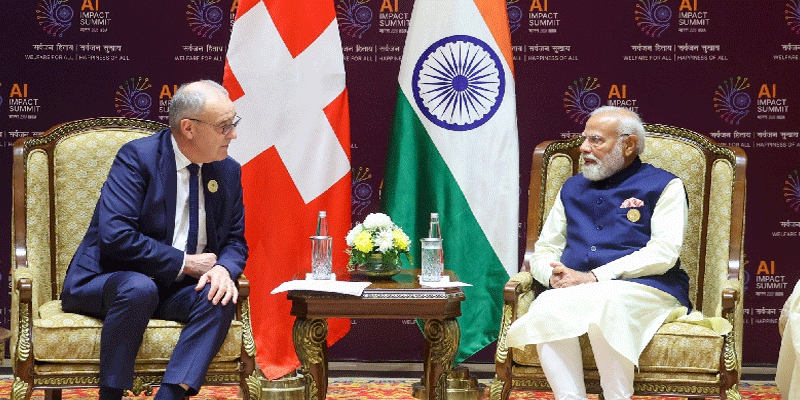
In a major boost to India’s clean-energy ambitions, Prime Minister Narendra Modi on Thursday announced that Australia will supply uranium to India after the two countries signed a key agreement in the field of nuclear energy. The announcement marks a significant milestone in bilateral relations, reinforcing energy security while deepening strategic cooperation between two key Indo-Pacific partners. Beyond ensuring a stable supply of nuclear fuel, the agreement underscores a broader convergence of economic, technological and geopolitical interests, reflecting the growing maturity of the India-Australia partnership.
Modi’s Australia Visit Strengthens Bilateral Ties
The uranium agreement emerged as one of the defining outcomes of Prime Minister Modi’s engagement with Australian leadership, where discussions extended well beyond energy cooperation. The visit built upon the rapidly expanding Comprehensive Strategic Partnership between the two countries, covering trade, defence, education, mobility, space, critical minerals, climate action and regional security. It also reaffirmed the shared vision articulated by Prime Minister Modi and Australian Prime Minister Anthony Albanese to build resilient supply chains and strengthen cooperation in sectors that will shape the future global economy.
Why the Agreement Matters
Australia’s uranium and critical minerals cooperation with India is far more than a commercial arrangement. It represents a strategic commitment to align resource security, industrial policy and long-term economic interests. India requires reliable nuclear fuel and critical mineral supplies to accelerate its low-carbon transition, while Australia is seeking to deepen economic engagement with one of the world's fastest-growing major economies.
For India, assured access to Australian uranium enhances fuel security for its expanding nuclear energy programme. At the same time, collaboration in critical minerals supports the development of batteries, clean-energy technologies and advanced manufacturing, helping diversify supply chains and reduce dependence on any single external source.
Strategic Significance Beyond Energy
The agreement reflects the broader transformation of India-Australia relations into a comprehensive strategic partnership. Cooperation today spans climate action, defence, science, space, trade and regional security, illustrating that uranium is only one component of a much wider framework of collaboration.
This growing alignment also carries considerable geopolitical significance. As both democracies seek a stable and resilient Indo-Pacific, deeper cooperation in strategic resources strengthens their collective ability to navigate increasingly complex global supply chains while promoting economic resilience.
Supporting India's Clean Energy Transition
Nuclear energy occupies a crucial place in India's long-term energy strategy because it provides reliable, low-carbon baseload electricity that complements renewable sources such as solar and wind, whose generation depends on weather conditions. As electricity demand rises with industrial expansion, urbanisation and digital infrastructure growth, dependable nuclear power becomes increasingly important.
India and Australia have consistently linked uranium cooperation with renewable energy, green hydrogen and critical minerals, highlighting a comprehensive clean-energy partnership rather than a standalone fuel arrangement.
Beyond Uranium: A Partnership Built on Trust
The expanding relationship now encompasses education, sports, defence-industrial collaboration, mobility and space cooperation. Prime Minister Modi's reference to cricket diplomacy symbolised how cultural connections have evolved into substantive statecraft. Energy cooperation therefore reflects not only shared economic interests but also growing political trust between two like-minded democracies.
A Defining Strategic Milestone
The uranium agreement is significant because it combines India's clean-energy transition with strategic resilience. By strengthening fuel security, supporting future nuclear capacity and fostering cooperation in critical minerals and advanced technologies, the partnership advances both countries' long-term interests. More importantly, it signals that India and Australia are moving beyond shared strategic concerns towards delivering tangible outcomes that reinforce sustainable development, economic security and a more resilient Indo-Pacific partnership.
(With agency inputs)