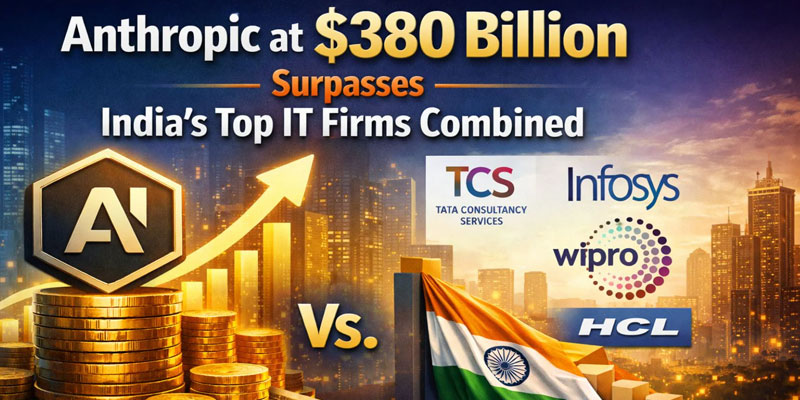
Started barely five years ago as an AI safety-focused research startup, Anthropic has now surged to a staggering $380 billion valuation following a $30 billion Series G funding round in February 2026. The round, led by Singapore’s sovereign wealth fund GIC and Coatue Management, with participation from Amazon, Google, Microsoft, and Nvidia, catapults the firm beyond the combined market capitalization of Indian IT heavyweights Tata Consultancy Services, Infosys, Wipro, and HCLTech.
The valuation milestone is more than symbolic—it signals a tectonic shift in where global capital believes the future of technology lies.
From Research Lab to Generative AI Powerhouse
Founded in 2021, Anthropic built its reputation around “constitutional AI,” emphasizing safety, alignment, and responsible outputs through its flagship Claude models. Unlike traditional software firms that scale through manpower and contracts, Anthropic scales through compute, intellectual property, and platform effects.
The $30 billion funding injection reflects investor conviction that frontier AI models will underpin the next decade of enterprise transformation. Revenue from APIs, custom enterprise deployments, and deep cloud integrations has converted early research credibility into commercial traction. In contrast to older tech firms that built value over decades, Anthropic’s ascent demonstrates how AI-native firms can compress growth cycles into a fraction of the time.
Its valuation multiples—reportedly over 100x forward revenue—reflect scarcity value: there are only a handful of companies globally capable of training frontier large language models at scale.
The Indian IT Contrast: Scale Without IP
The comparison with India’s IT giants is stark. TCS, Infosys, Wipro, and HCLTech collectively represent decades of dominance in outsourcing, cloud migration, and enterprise services. Their business model—cost arbitrage combined with operational excellence—has delivered consistent cash flows and export revenues exceeding $250 billion annually.
However, these firms trade at far more conservative multiples, typically 15–25 times earnings. Their strength lies in execution, not proprietary AI platforms. While they are investing heavily in generative AI labs and partnerships—often building solutions on top of Claude or GPT models—they do not own foundational AI models themselves.
This exposes a structural gap. AI-native companies capture intellectual property premiums, while services firms risk becoming integrators of someone else’s innovation. With generative AI automating coding and business processes, even 20–30% of repetitive IT tasks could face disruption, challenging the labour-intensive foundation of India’s tech sector.
Strategic and Geopolitical Implications
Anthropic’s rise underscores a broader capital reallocation toward AI infrastructure and compute-intensive innovation. The participation of hyperscalers and chipmakers like Nvidia tightens the U.S.-centric AI ecosystem, deepening technological bipolarity between a handful of American firms and the rest of the world.
For India, this moment is both warning and opportunity. As policymakers push for AI self-reliance and domestic cloud ecosystems, the gap in foundational model development becomes more pronounced. Without stronger R&D incentives and startup capital, India risks remaining a services backend to global AI leaders.
A Wake-Up Call for the Services Economy
Anthropic’s $380 billion valuation is not merely a funding headline—it is a signal that the center of gravity in technology has shifted from services to sovereign AI capability. For India’s IT titans, the challenge is existential: innovate beyond integration or risk commoditization. The future belongs not just to those who implement AI, but to those who build it.
(With agency inputs)