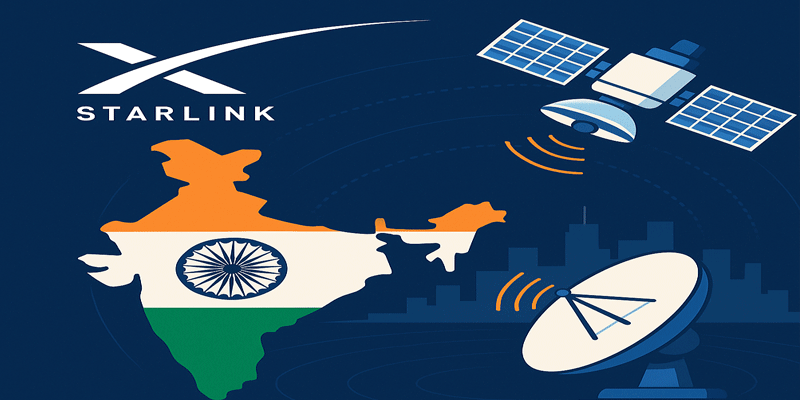
Gujarat has moved to deploy satellite-based broadband in remote and underserved regions through a new partnership with Elon Musk’s Starlink. The state government signed an agreement aimed at delivering high-speed connectivity to tribal belts, coastal zones, and border districts, positioning the initiative as a pilot for wider national adoption. The deal marks one of the most concrete steps yet in integrating low-Earth orbit (LEO) satellite internet into India’s digital infrastructure strategy.
Starlink’s Entry and Business Prospects in India
Starlink, operated by SpaceX, uses thousands of LEO satellites to provide broadband in areas where traditional fibre or mobile networks are limited. Globally, the service has expanded rapidly, offering speeds capable of supporting streaming, telemedicine, and enterprise connectivity. Its India ambitions faced early regulatory hurdles, but recent licensing approvals and security clearances have cleared a path for operations. The company now aims to combine direct-to-consumer services with government and enterprise partnerships to scale across rural and remote regions.
India represents a significant market for satellite broadband due to persistent connectivity gaps in difficult terrain and sparsely populated areas. Starlink’s model—high-speed internet delivered via satellite terminals—offers a complementary solution to terrestrial networks rather than a direct replacement.
Gujarat as a Pilot: Scope and Strategy
The Gujarat agreement focuses on government-led deployment. Under the arrangement, satellite connectivity will support public institutions such as schools, primary health centres, and administrative offices, while also enabling telemedicine, disaster response, and digital governance. The state is expected to procure services in bulk and extend them to communities through local partners, lowering costs for end users.
This public-sector-driven approach differs from purely commercial rollouts, as it prioritises digital inclusion in areas where connectivity remains limited. Officials see the initiative as aligning with broader national goals to expand digital services and strengthen infrastructure in remote districts.
Comparing the Gujarat Deal with Jio and Airtel Partnerships
Starlink has also explored collaboration with major Indian telecom firms, including Reliance Jio and Bharti Airtel. These partnerships focus primarily on distribution, customer support, and integration with existing networks. Jio’s model emphasises large-scale consumer reach through bundled plans and ground infrastructure, leveraging its vast subscriber base. Airtel, meanwhile, is positioned to integrate satellite connectivity into enterprise and hybrid network solutions, complementing its own satellite ventures.
In contrast, Gujarat’s agreement is anchored in government procurement and public-service delivery. While telecom partnerships target retail and enterprise customers nationwide, the state-led model prioritises connectivity in underserved areas first. The approaches are therefore complementary: telecom companies provide scale and commercial reach, while the Gujarat pilot demonstrates how satellite broadband can support governance and rural development.
Opportunities and Challenges
The initiative could significantly improve connectivity in regions prone to infrastructure challenges, enhancing access to education, healthcare, and digital services. However, affordability, spectrum policy, and security considerations remain critical factors. Ensuring cost-effective terminals and integrating satellite systems with existing telecom networks will determine long-term success.
A Test Case for Satellite Connectivity in India
Gujarat’s partnership with Starlink represents a strategic experiment in bridging India’s digital divide through satellite technology. By combining public-sector deployment with private-sector innovation, the initiative could shape how satellite broadband integrates into the country’s broader connectivity ecosystem. If successful, the model may inform national expansion and complement telecom-led rollouts, bringing reliable internet access to regions that have long remained beyond the reach of conventional networks.
(With agency inputs)