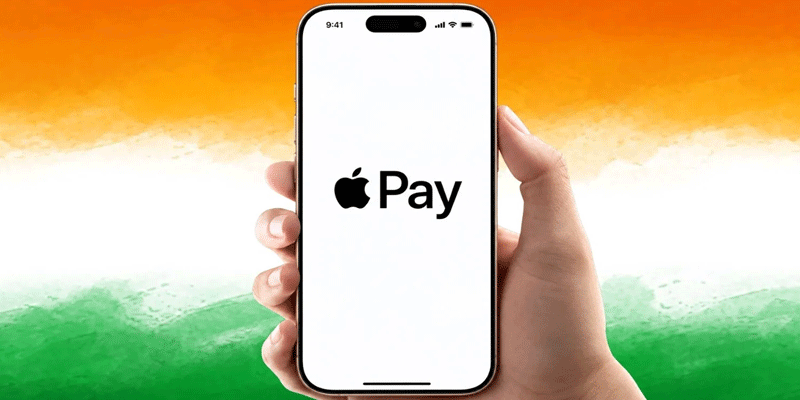
Apple is gearing up to launch Apple Pay in India, marking one of its most ambitious localisation efforts in a major emerging market. The iPhone maker is in talks with leading Indian banks including ICICI Bank, HDFC Bank and Axis Bank, alongside global card networks Visa and Mastercard. If negotiations progress smoothly, Apple Pay could debut around mid-2026—though timelines remain fluid.
Strategic Context: Entering the World’s Most Dynamic Payments Market
India represents a paradox for Apple. While iOS commands a relatively small share of smartphones, the country is the fastest-growing large digital payments ecosystem globally, powered by the public infrastructure of Unified Payments Interface. For Apple, launching Apple Pay here is both a strategic bet and a test of adaptability.
Initial reports suggest Apple will begin with tokenised, card-based contactless payments through partner banks, targeting affluent urban iPhone users who already over-index on credit card ownership. A phased integration with UPI is expected later, allowing Apple to align with India’s dominant payment rail without directly competing against it.
Product Design: How Apple Pay in India Will Differ Globally
Globally, Apple Pay is built around NFC “tap-to-pay” transactions, using tokenised card credentials stored securely on-device and authenticated via Face ID or Touch ID. In markets like the US or UK, contactless terminals form the backbone of merchant acceptance.
India flips that equation. The local version of Apple Pay is expected to prioritise QR code scanning and UPI-style real-time bank transfers over pure NFC taps. Instead of relying solely on NFC-enabled POS machines, Apple Pay may allow users to scan ubiquitous QR codes and initiate direct bank-to-bank payments—similar to flows seen on domestic apps.
Authentication will remain Apple’s differentiator. While UPI traditionally requires a PIN for transaction authorisation, Apple is reportedly exploring biometric overlays, enabling Face ID or Touch ID for QR-based UPI payments, reducing friction without compromising security. Card-based NFC payments would continue using global tokenisation standards.
Merchant reach will also expand dramatically under a UPI model. Unlike NFC terminals, QR codes require minimal hardware and are accepted by millions of merchants—from urban retailers to small roadside vendors—making Apple Pay more inclusive than its traditional NFC-centric approach.
However, there are structural differences. UPI transactions require real-time internet connectivity and carry zero consumer fees, constraining Apple’s ability to replicate higher-margin interchange models common in developed markets.
Competitive Landscape and Regulatory Constraints
Apple Pay will enter a fiercely competitive market dominated by UPI-first apps. While it is unlikely to displace incumbents at mass scale, it could capture a premium niche: privacy-conscious, high-spending iPhone users with multiple cards and higher transaction values.
Regulatory oversight from the Reserve Bank of India and payment authorities will also shape Apple’s model, particularly around data localisation, fee structures and market concentration.
A Template for Emerging Markets?
If Apple successfully merges global card tokenisation with India’s public digital rails, it could redefine the premium payments experience without challenging UPI’s mass dominance. More importantly, an India-optimised Apple Pay—blending QR, UPI, transit and in-app payments—may become a strategic blueprint for how global tech firms adapt to sovereign digital public infrastructure worldwide.
India will not simply receive Apple Pay; it will reshape it.
(With agency inputs)