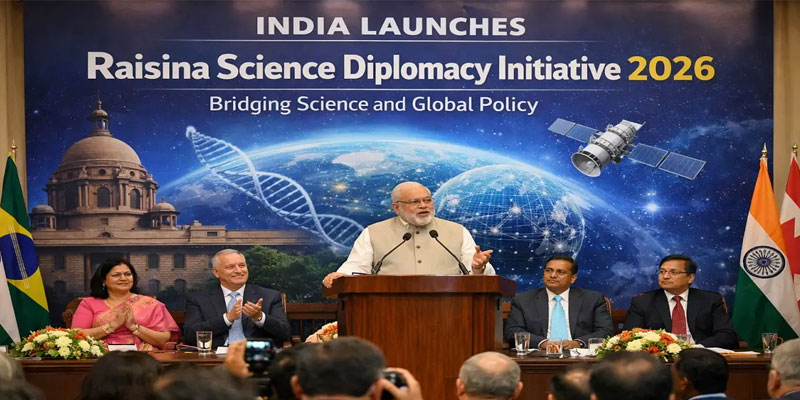
Global Strategic Forum Opens in New Delhi
The annual Raisina Dialogue began in the national capital on March 5, bringing together global leaders, policymakers, diplomats and technology experts to deliberate on pressing geopolitical and economic challenges. Hosted jointly by the Observer Research Foundation and the Ministry of External Affairs (India), the three-day forum has emerged as one of the world’s leading platforms for strategic conversations.
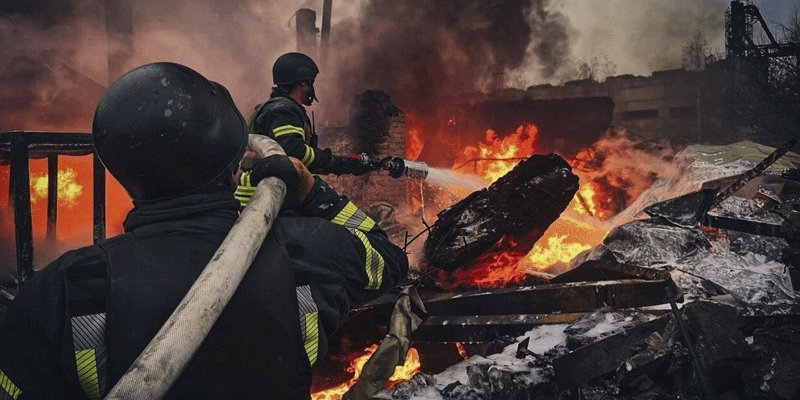
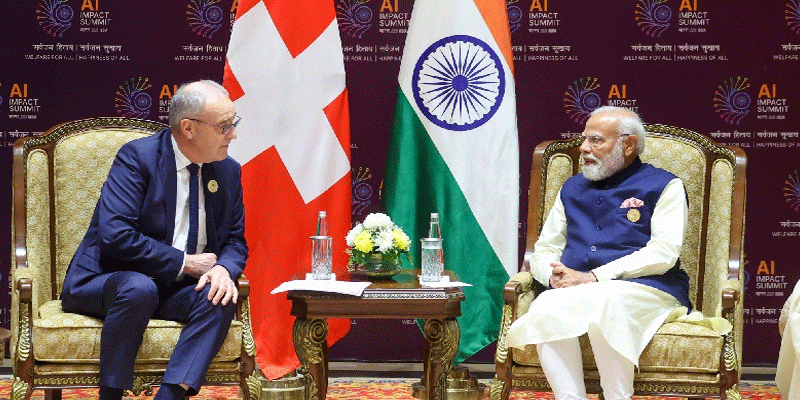
The 2026 edition, themed “Samskara: Assertion, Accommodation, Advancement,” comes at a time of deep global uncertainty marked by conflicts in West Asia, tensions in Eastern Europe and the intensifying race for technological dominance. The event was inaugurated by Narendra Modi, alongside Alexander Stubb, President of Finland, underscoring India’s growing role as a convenor of global strategic dialogue.
Key Leaders and Global Voices at Raisina
The conference has drawn more than 3,000 delegates from across governments, academia, business and civil society. Among the prominent figures attending the dialogue are: S. Jaishankar, India’s External Affairs Minister, Christopher Landau, Jane Holl Lute, Vikram Misri, Nandan Nilekani, Co-founder of Infosys, Smita Prakash, Editor of ANI, Corey Thomas and Marise Payne, former Foreign Minister of Australia.
Regional leaders participating include Ian Borg, Deputy Prime Minister of Malta; D. N. Dhungyel, Foreign Minister of Bhutan; Dhananjay Ramful of Mauritius; Barry Faure of Seychelles; and Vijitha Herath of Sri Lanka.
Day One: Alliances in a Technopolar World
The opening day focused on the transformation of global alliances in what experts describe as a “technopolar” world—where power is increasingly shaped by digital infrastructure, artificial intelligence and semiconductor supply chains. Discussions explored the future of transatlantic security, the evolving role of NATO, and the shifting balance between traditional military alliances and technology-driven influence.
Panels under the pillar “Contested Frontiers” examined sovereignty, strategic competition and the future of global power structures, while “Repairing the Commons” explored how multilateral cooperation can address transnational challenges.
Day Two: Security Competition and Technology Rivalries
The second day is set to focus on geopolitical flashpoints and emerging technology competition. Key sessions will examine deterrence dynamics in the Taiwan Strait, the strategic implications of semiconductor supply chains and the widening defence capability gap between Western nations and Russia.
Debates will also scrutinize the credibility of the United Nations Security Council in an era of unilateral actions and geopolitical fragmentation. Regional discussions will spotlight Africa’s demographic rise, Latin America’s mineral resources vital for AI technologies, and the evolving strategic triangle between India, Europe and Russia.
Day Three: Connectivity, Climate and Economic Resilience
The final day will shift focus toward economic resilience, global connectivity and climate-linked conflicts. Under the pillars “Tomorrowland” and “Eleventh Hour,” participants will discuss technology governance, trade transformation, climate-security risks and pathways to achieving the United Nations Agenda 2030 development goals.
India’s Strategic Voice in a Fragmenting World
As global crises—from Middle East conflicts to energy insecurity—reshape international politics, the Raisina Dialogue serves as a critical forum for bridging perspectives across regions and sectors. By convening diverse voices on geopolitics, technology and sustainability, India positions itself as a key facilitator of dialogue in an increasingly fragmented world.
The conversations unfolding in New Delhi may not produce immediate policy decisions, but they shape the strategic thinking that influences global governance. In an era defined by rivalry and rapid technological change, the Raisina Dialogue underscores India’s ambition to play a central role in shaping a more cooperative and resilient international order.
(With agency inputs)