Industrial Gas Prices Surge Amid Middle East Tensions
Industrial gas consumers in India are facing a sudden price shock after Adani Total Gas raised rates sharply in response to supply disruptions linked to the escalating conflict in the Middle East. The company announced that industrial gas prices will rise to ₹119 per standard cubic meter (SCM) for volumes exceeding 40 percent of contracted daily supply, a steep jump from roughly ₹40/SCM earlier.
The hike, effective from March 4, 2026, reflects tightening global liquefied natural gas (LNG) supplies triggered by the ongoing war involving the United States and Iran. As tensions intensify in the region, the ripple effects are already reaching India’s energy markets and industrial supply chains.
Disruptions at the Strait of Hormuz
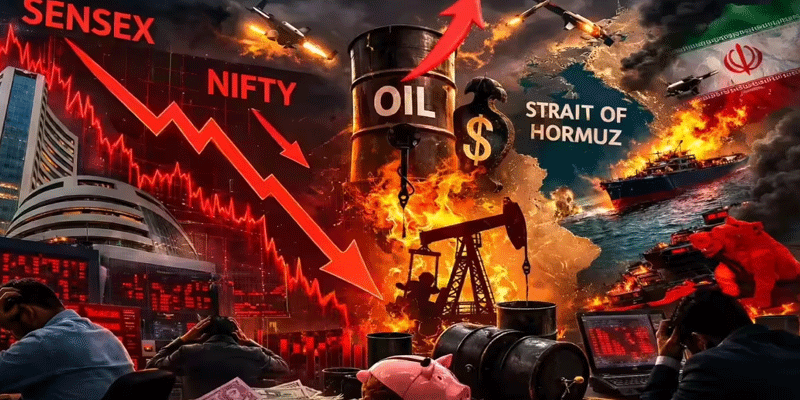
At the heart of the crisis lies the strategic Strait of Hormuz—one of the world’s most important energy corridors. The narrow waterway carries nearly 20 percent of global oil shipments, amounting to about 21 million barrels per day, and handles around 80 million tonnes of LNG annually, most of it exported from Qatar.
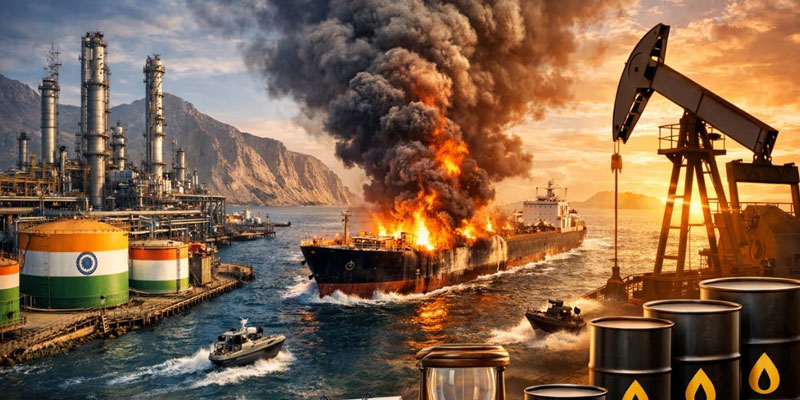
Following missile attacks on tankers and warships in the region, maritime traffic has slowed dramatically, with reports indicating that more than 250 vessels have been trapped or rerouted. The disruption has stranded over one million tonnes of LNG cargo destined for Asian markets, including India.
The impact has been immediate. Brent crude prices have climbed to around $80 per barrel, while LNG benchmark prices have surged beyond $20 per MMBtu, approaching levels seen during the global energy crisis triggered by the Ukraine war.
Why Adani Total Gas Raised Prices
The company said it would continue to prioritize contracted gas supplies for its industrial customers. However, users consuming beyond 40 percent of their contracted quantity will face the higher rates due to limited LNG availability.
Importantly, the company clarified that compressed natural gas (CNG) and piped natural gas (PNG) prices for households will remain unchanged, insulating residential consumers for now. Despite the reassurance, the market reacted nervously, with ATGL shares falling nearly 4 percent in trading following the announcement.
India’s Energy Vulnerability
India’s dependence on imported energy makes it particularly vulnerable to disruptions in the Gulf region. Nearly half of the country’s LNG requirements are imported, and a large share of these supplies travel through the Strait of Hormuz.
The disruption has already reduced India’s LNG inventory from roughly 15 days of supply to less than 10 days in some terminals. The Petronet LNG terminal at Dahej, for example, has reported critically low stocks after declaring force majeure on certain cargoes from Qatar.
Energy companies such as GAIL and Petronet LNG have seen their shares decline amid fears of rising procurement costs. Analysts estimate that if the disruption persists, gas prices for Indian industries could increase by ₹20–30 per SCM, squeezing profit margins in sectors such as textiles, chemicals, ceramics, and fertilizers.
How a Strait of Hormuz Closure Impacts Global Gas Markets
A prolonged closure or severe disruption in the Strait of Hormuz would send shockwaves across global gas markets. Since Qatar is one of the world’s largest LNG exporters, any halt in shipments from its Ras Laffan export terminals could slash nearly 19 percent of global LNG supply.
The ripple effects are already visible. Europe’s TTF gas benchmark has jumped about 45 percent, Asian spot LNG prices have surged by roughly 40 percent, and LNG freight costs have risen by around 40 percent as vessels seek longer alternative routes.
In Asia, countries such as India, China, Japan, and South Korea—heavily reliant on Qatari LNG—would face fierce competition for cargoes from the United States and Australia. Such supply tightness could push prices toward $30 per MMBtu, levels last seen during the 2022 energy crisis.
A Warning Signal for Energy Security
The price hike by Adani Total Gas illustrates how geopolitical conflicts can quickly cascade into domestic economic pressures. From industrial input costs to inflation risks, the effects of energy disruptions travel far beyond the battlefield.
For India, the episode underscores the urgent need to diversify energy sources, strengthen strategic reserves, and accelerate investments in domestic gas production and renewable energy. While short-term measures such as sourcing LNG from alternative exporters may ease immediate pressure, the long-term lesson is clear: energy security must remain at the heart of India’s economic strategy in an increasingly volatile world.
(With agency inputs)