India’s Helicopter Push
Hindustan Aeronautics Limited (HAL) is set to expand its aero-engine manufacturing capacity with a second production line for the Shakti helicopter engine at its Koraput facility in Odisha. The ₹218-crore initiative comes as India prepares for a major expansion of its indigenous helicopter fleet and seeks greater control over critical defence technologies.
Koraput’s Long Aero-Engine Legacy
HAL’s Koraput facility has been central to India’s aerospace manufacturing journey since its establishment in 1964. Over the decades, it has produced and overhauled engines powering several combat aircraft, including the MiG-21, MiG-27, MiG-29 and Su-30MKI.
The planned Shakti line therefore represents more than additional production capacity. It connects Koraput’s decades-long experience in aero-engine manufacturing with India’s current ambition to build a stronger domestic helicopter ecosystem.
Second Shakti Line Signals Bigger Production
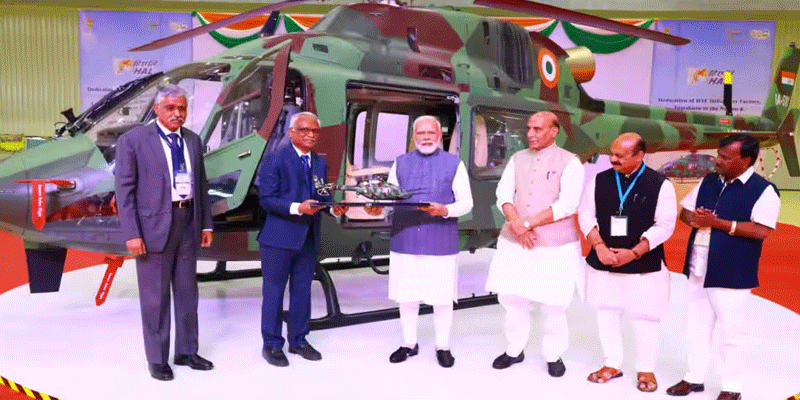
The immediate requirement comes from growing demand for engines powering the Advanced Light Helicopter (ALH) Dhruv and Light Combat Helicopter (LCH) Prachand. Defence Minister Rajnath Singh is scheduled to inaugurate the initiative on October 6, alongside an event marking HAL Koraput’s delivery of its 2,000th aero-engine.
The expansion is closely linked to the government’s ₹62,700-crore contract with HAL for 156 Prachand helicopters:
· 66 helicopters for the Indian Air Force
· 90 helicopters for the Indian Army
· Deliveries beginning in the third year of the contract
· Production continuing over a five-year period
The sustained requirement makes reliable engine production crucial to maintaining the helicopter delivery schedule.
Shakti Becomes Critical to Helicopter Ambitions
The Shakti is an Indian version of the Ardiden 1H1 turboshaft engine, developed through cooperation between HAL and France’s Safran Helicopter Engines. It powers both the Dhruv and Prachand, making engine availability a critical component of India’s helicopter modernisation programme.
HAL currently produces around 80 Shakti engines annually at Bengaluru. The additional line is expected to help raise overall production capacity to approximately 180 engines a year, significantly improving the ability to support the expanding helicopter fleet.
The Prachand is particularly important for India’s high-altitude military requirements. Its ability to operate above 5,000 metres makes it suited to demanding Himalayan environments, where air support can be vital for surveillance, mobility and combat operations.
Indigenous Content Strengthens Defence Manufacturing
The Prachand programme also carries a substantial industrial objective. The government has targeted more than 65% indigenous content, with over 250 Indian companies, largely MSMEs, expected to participate.
This could strengthen domestic capabilities in:
· Precision engineering and metallurgy
· Aerospace components and systems
· Avionics and engine-related technologies
· Maintenance and support ecosystems
Such participation can gradually reduce dependence on overseas suppliers while creating a wider defence-industrial base.
From Licensed Production to Indigenous Engine Expertise
Yet increased production should not be confused with complete technological independence. Modern aero-engine development requires expertise in high-temperature materials, turbine design, combustion, engine controls, testing and certification.
In this context, HAL’s cooperation with Safran on the 3,500–4,000-shaft-horsepower Aravalli turboshaft engine assumes strategic importance. It could provide a pathway from technology-assisted production towards deeper joint development and eventually greater indigenous design capability.
From Engine Production to Strategic Self-Reliance
The second Shakti line is ultimately significant because it strengthens the industrial foundation beneath India’s helicopter ambitions. Higher production capacity can accelerate deliveries, support operational readiness and deepen domestic manufacturing.
But the larger measure of success will be whether Koraput’s manufacturing strength evolves into technological ownership. India’s long-term aerospace ambition is not merely to assemble more engines, but to master their design, development and production. The Shakti expansion can be an important step on that demanding journey.
(With agency inputs)