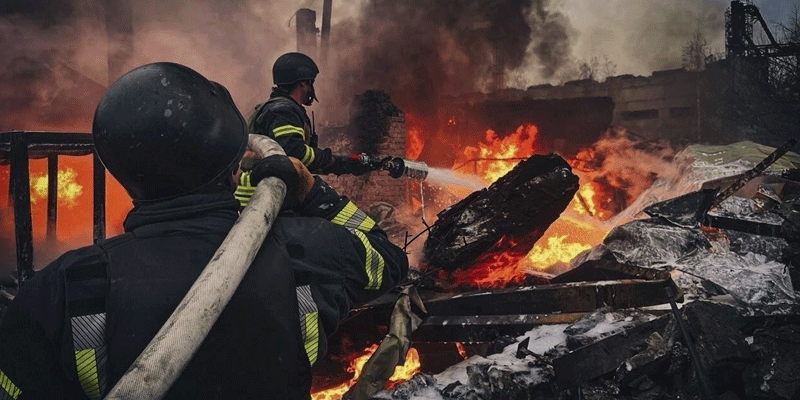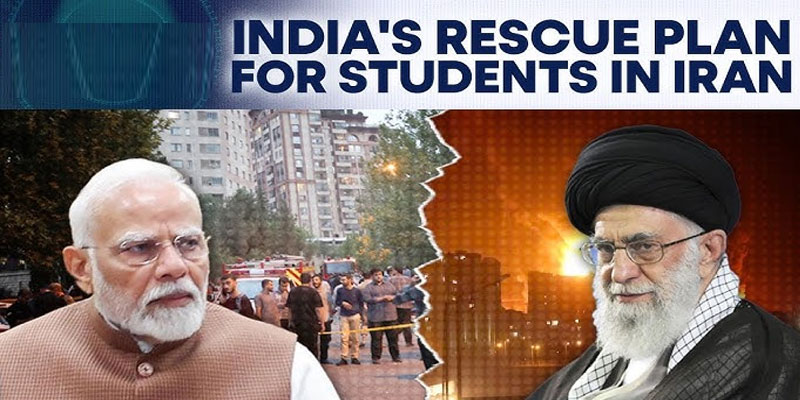
The spiralling US–Israel–Iran war has triggered one of the gravest geopolitical crises of the decade, sending shockwaves through West Asia and beyond. Following coordinated US–Israeli strikes that eliminated Iran’s Supreme Leader and senior IRGC commanders, Tehran retaliated with missile and drone barrages across Israel and key Gulf hubs. Airspace closures, oil price spikes, and market suspensions have deepened uncertainty. For India—home to nearly 9.6 million nationals across the Middle East—the conflict is not distant geopolitics but an immediate humanitarian, economic, and strategic challenge.
CCS Deliberations: Crisis Management at 7RCR
On March 1, 2026, Prime Minister Narendra Modi convened a late-night Cabinet Committee on Security (CCS) meeting at 7, Lok Kalyan Marg. Present were Defence Minister Rajnath Singh, Home Minister Amit Shah, External Affairs Minister S. Jaishankar, Finance Minister Nirmala Sitharaman, National Security Adviser Ajit Doval, and Chief of Defence Staff Anil Chauhan.
The CCS reviewed the dramatic escalation: targeted killings in Tehran, retaliatory strikes on Israel and Gulf states, and intensifying regional instability. Four priorities dominated discussions—safety of Indian nationals (3.5 million in the UAE, 2.6 million in Saudi Arabia), safeguarding energy security (India imports 85% of its crude), protection of maritime trade routes through the Strait of Hormuz, and calibrated diplomacy aimed at de-escalation.
Modi directed embassies to activate war rooms, ordered naval patrol reinforcements, and stressed dialogue even as contingency planning accelerated.
Airline Disruptions and Aviation Paralysis
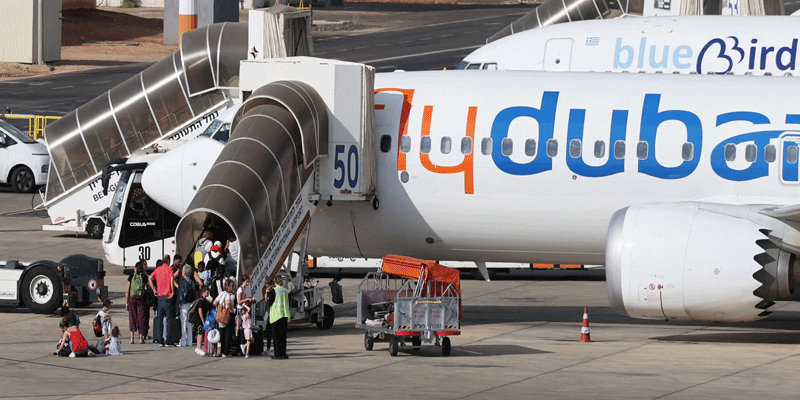
The war’s immediate fallout was felt in the skies. Closure of Iranian, Iraqi, and Jordanian airspace led to sweeping cancellations. Air India axed over 50 flights on March 1–2, affecting routes to Dubai, Sharjah, and Doha, while offering rebooking, refunds, and travel vouchers. IndiGo suspended more than 160 international flights through March 2 (23:59 IST), extending waivers for Middle East travel booked before February 28.
In total, 444 flights were grounded on March 1 alone, according to the aviation ministry. Key destinations impacted included Abu Dhabi, Riyadh, Jeddah, Muscat, and Doha. European carriers such as Lufthansa rerouted services, while Indian operators pivoted aircraft to domestic sectors. Safety amid missile and drone threats remained paramount.
Evacuating 9.6 million: India’s Contingency Blueprint
India’s evacuation architecture draws upon precedents like Operation Rahat (Yemen, 2015) and Vande Bharat (COVID-19 repatriations). The demographic spread is vast: approximately 9–10 million Indians across Gulf states, including 3.5 million in the UAE, 2.6 million in Saudi Arabia, 800,000 in Qatar, over a million combined in Oman, Kuwait, and Bahrain, around 18,000 in Israel, and about 1,200 students in Iran.
The CCS tasked the Ministries of External Affairs, Defence, and Home Affairs with an Ops Sankalp-like framework. Over 100 flights are on standby, supported by Indian Air Force C-17 aircraft and chartered commercial jets. Naval vessels, including amphibious platforms, are prepared for sea evacuations through Oman, Jordan, or Egypt if air corridors collapse.
MEA control rooms operate 24/7, supported by country-specific helplines. Registration via embassy portals and the Pravasi Bharatiya Sahayata Kendra app has crossed 80% in the UAE. Phased evacuation prioritizes vulnerable laborers, students, and families. Estimated costs—₹500 to ₹1,000 crore—may be partly offset through NRI levies.
Strategic Stakes: Oil, Remittances, and Diplomacy
Oil has surged to $85 per barrel—a 10% spike—threatening inflation and fiscal stability. India’s $100 billion annual remittances, much of it from GCC workers, face disruption. Nearly 40% of India’s overseas labor exports are Gulf-bound.
Diplomatically, India walks a tightrope. Strong ties with Israel coexist with historical energy engagement with Iran. The Navy monitors piracy risks in the Red Sea and Arabian Sea, while Jaishankar’s outreach underscores India’s G20-aligned call for de-escalation through dialogue.
Balancing Resolve and Restraint
The March 1 CCS meeting reflects India’s evolving crisis management doctrine—swift coordination, calibrated diplomacy, and large-scale logistical readiness. With 9.6 million lives and vital economic arteries at stake, the government’s “no one left behind” posture blends military preparedness with humanitarian urgency. Yet the scale dwarfs previous evacuations, testing administrative bandwidth amid global polycrises. As West Asia teeters, India’s response will shape not only the safety of its diaspora but also its standing as a stabilizing power in an increasingly fractured world.
(With agency inputs)