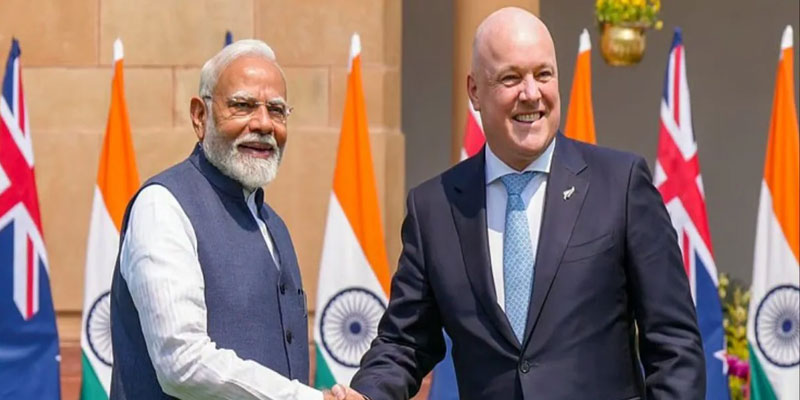
Christopher Luxon has mounted a robust defense of a landmark free trade agreement (FTA) with India, set to be signed on April 27 in New Delhi, even as political opposition intensifies at home. The agreement, years in the making and finalized in December 2025, promises sweeping tariff reductions and expanded market access. Yet concerns over immigration provisions and perceived imbalances have stirred unease among coalition partners and critics. Luxon, however, has framed the deal as a transformative economic opportunity, urging lawmakers to look beyond short-term political friction.
Agreement Overview: A Wide-Ranging Trade Reset
The FTA represents one of New Zealand’s most ambitious trade initiatives in recent years. It eliminates tariffs on 95% of timber and wood exports to India immediately, with the remaining duties phased out over seven years. This is significant given existing tariffs of 5.5–11% that previously hindered New Zealand exporters.
More broadly, 57% of New Zealand exports will gain duty-free access upon implementation, eventually rising to 82%. Key sectors benefiting include wool, coal, wine, avocados, and blueberries. On the other side, India secures zero-duty access for all its exports to New Zealand, while liberalizing 70% of its tariff lines—covering 95% of trade value—though it retains protections for sensitive sectors such as dairy and certain agricultural goods.
Political Opposition: Roots of Resistance
Despite the economic promise, the agreement has triggered notable political resistance. Coalition partner New Zealand First, led by Winston Peters, has emerged as a vocal critic. Peters has characterized the deal as “racially slanted,” arguing that provisions facilitating the movement of skilled Indian workers could disadvantage local labor markets.
At the core of this opposition is a broader anxiety about immigration. Critics fear that easing entry for Indian professionals in sectors like IT, healthcare, and engineering could suppress wages or reduce job opportunities for New Zealand citizens. These concerns are amplified in a domestic climate already sensitive to workforce competition and housing pressures.
The opposition New Zealand Labour Party initially raised economic concerns of its own, particularly the exclusion of dairy products—a cornerstone of New Zealand’s export economy. However, after securing concessions such as a one-year review mechanism for dairy access and tighter oversight on migration provisions, Labour shifted to support the agreement, enabling a broader parliamentary consensus.
Economic Implications: Growth Versus Risk
Economically, the FTA is poised to significantly deepen bilateral trade, which stood at $2.07 billion in 2024. Projections suggest this could more than double to $5 billion within five years. New Zealand exporters are expected to save between $45 million and $62 million annually through tariff reductions, particularly in forestry and agricultural products.
India, meanwhile, gains expanded access across 118 service and goods sectors, boosting exports in textiles, pharmaceuticals, leather, and IT services. The agreement also includes a forward-looking clause aimed at attracting up to $20 billion in Indian foreign direct investment into New Zealand over 15 years.
Strategic Stakes and Long-Term Vision
Beyond economics, the deal carries significant strategic weight. For India, it strengthens diversification efforts and enhances its footprint in the Indo-Pacific. For New Zealand, it opens access to a vast consumer base of over 1.4 billion people, helping offset stagnation in traditional markets.
Politics Versus Potential
The tension surrounding the FTA underscores a classic policy dilemma—balancing domestic sensitivities with global opportunity. While critics raise valid concerns about labor market impacts and sectoral exclusions, the broader trajectory points toward economic expansion and strategic alignment. Luxon’s unwavering stance reflects confidence that the long-term gains—in trade, investment, and geopolitical relevance—will outweigh the immediate political costs. Whether that optimism holds will depend not just on ratification, but on how effectively both nations translate policy into tangible benefits.
(With agency inputs)