Burying the Shadow of a Troubled Decade
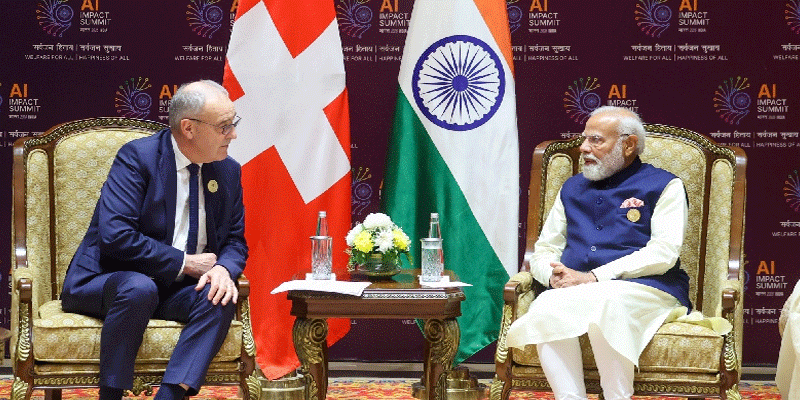
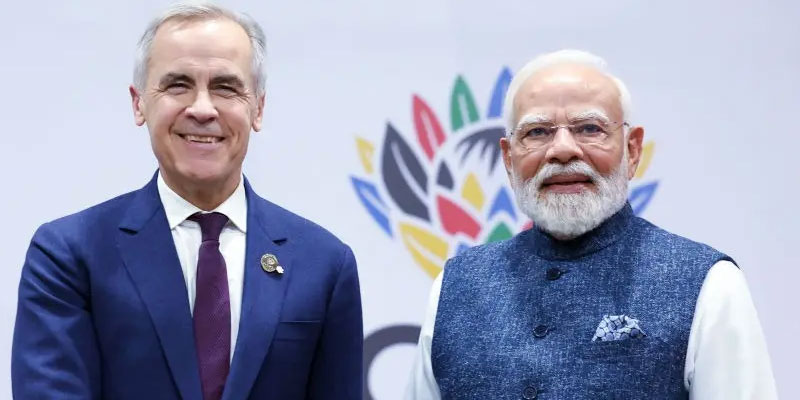
Canadian Prime Minister Mark Carney will visit India from February 26 to March 7, 2026, in what is widely seen as a decisive reset in bilateral relations. The trip—the first by a Canadian leader since ties deteriorated under the previous administration—signals Ottawa’s intent to turn the page on recent tensions. According to a statement from the Canadian Prime Minister’s Office, Carney will begin in Mumbai, engaging with business leaders, before travelling to New Delhi for high-level talks with Prime Minister Narendra Modi on March 2.
A telling departure from past protocol was Carney’s decision not to visit Punjab, breaking from the precedent set by earlier Canadian leaders who often included the Sikh-majority state in their itineraries. The omission was widely interpreted as a signal: Ottawa intends to prioritize state-to-state engagement over domestic vote-bank optics. Trade, technology, clean energy, and security cooperation—not symbolism—define the agenda.
The Trudeau Years: From Strain to Breakdown
Under former Prime Minister Justin Trudeau, bilateral ties reached their nadir. The rupture crystallized in September 2023 when Trudeau told Canada’s Parliament that there were “credible allegations” linking Indian agents to the killing of Khalistani separatist Hardeep Singh Nijjar outside a Surrey gurdwara.
New Delhi dismissed the accusation as “absurd and motivated,” demanding evidence and accusing Canada of providing safe haven to extremist elements advocating Khalistan. What followed was an escalating diplomatic tit-for-tat: expulsions of senior diplomats, suspension of visa services, intelligence cooperation freezes, and stalled trade talks.
The crisis exposed deeper fissures. India had long expressed concerns about what it viewed as Ottawa’s permissiveness toward separatist activism, particularly events glorifying figures like Talwinder Singh Parmar, associated with the 1985 Air India bombing. Canada, meanwhile, framed its position within the ambit of free speech and rule of law.
By 2024, relations had virtually frozen. Trade plateaued at roughly $8 billion annually, negotiations on a Comprehensive Economic Partnership Agreement (CEPA) were paused, and diaspora communities—numbering nearly 1.8 million Indian-origin Canadians—found themselves caught in diplomatic crossfire.
Carney’s Strategy: Economic Realism over Political Optics
Carney’s approach signals a deliberate pivot. His government has de-emphasized Trudeau-era allegations, cooperated with investigations, and quietly restored student visa flows—an important economic and social bridge between the two countries.
Economic pragmatism dominates the reset. Discussions during the visit reportedly focus on critical minerals, artificial intelligence, semiconductors, agri-exports, and clean energy collaboration. Canada’s reserves of rare earths and minerals such as indium are being pitched as vital inputs for India’s electric vehicle and renewable energy ambitions.
Both sides are exploring frameworks to boost bilateral trade by $5 billion by 2028 and revive CEPA negotiations. Quarterly trade dialogues and the reinstatement of high commissioners are also under consideration, signaling institutional normalization.
Carney’s technocratic credibility—honed during his tenure at the Bank of England—adds weight to his economic outreach. Unlike the Trudeau years, where identity politics often intersected with foreign policy, the new administration appears intent on insulating diplomacy from domestic polarization.
A Shared Interest in Strategic Diversification
The reset comes at a time of global realignment. India values Canada’s G7 stature and resource wealth as it seeks to diversify supply chains away from China. Canada, navigating renewed US protectionism and tariff volatility, sees India’s 1.4 billion-strong market as a growth counterbalance.
Shared Indo-Pacific concerns and expanding people-to-people ties reinforce mutual incentives to stabilize relations.
From Estrangement to Engagement
Mark Carney’s India visit represents more than diplomatic choreography; it reflects a structural recalibration of Canada’s foreign policy priorities. While residual tensions over separatism and human rights persist, both capitals recognize the strategic cost of prolonged estrangement.
If sustained, this reset could restore trust, revive trade momentum, and elevate India–Canada ties to pre-2023 levels. By consciously stepping out of Trudeau’s shadow, Carney is betting that pragmatic realism—not rhetorical confrontation—offers the only viable path forward.
(With agency inputs)