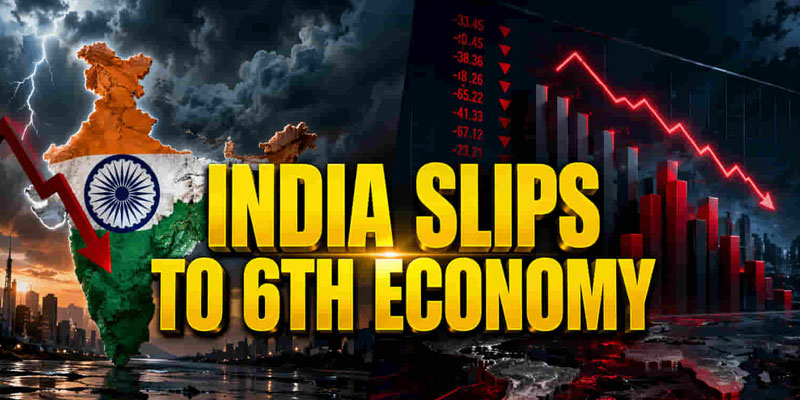
India slipped to the sixth-largest economy in 2025 as rupee weakness eroded gains in dollar terms, even as the country maintained strong growth momentum. According to the latest projections by the International Monetary Fund, India’s ascent to the world’s third-largest economy is now expected to be delayed until 2031—highlighting how currency dynamics can reshape global rankings despite robust domestic performance.
Global Rankings: Where India Stands
In nominal GDP terms, India’s economy reached approximately $3.92 trillion in 2025. However, it was overtaken by both Japan ($4.44 trillion) and the United Kingdom ($4 trillion), pushing it down from fifth place in 2024 to sixth.
The global order remains led by the United States and China, followed by Germany, Japan, and the UK. France trails just behind India. While the slip may appear modest, it underscores the importance of exchange rates in determining global economic standing.
Interestingly, in purchasing power parity (PPP) terms, India continues to hold the third position globally—indicating strong domestic economic activity and consumption strength.
The Rupee Factor: Why Currency Matters
The primary reason behind India’s ranking drop is the depreciation of the rupee. In 2025, the currency averaged around ₹85 per US dollar, weakening significantly compared to the previous year. This decline reduced the dollar value of India’s GDP despite healthy real growth.
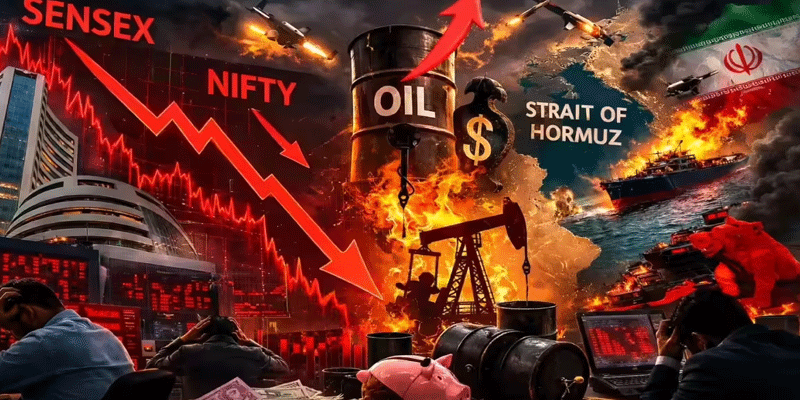
Several factors contributed to this trend. A widening trade deficit—driven by heavy imports of oil, electronics, and machinery—put pressure on the rupee. Rising global oil prices, exacerbated by geopolitical tensions, further strained the current account.
Additionally, capital outflows and tighter monetary policies in the United States led to reduced foreign investment inflows. The Reserve Bank of India intervened in currency markets, but largely prioritized stability over aggressive defense of the rupee.
Growth Story Intact: A Temporary Setback
Despite the ranking slip, India remains the fastest-growing major economy, with projected real GDP growth of 6.5–7%. The IMF expects India to regain momentum in the coming years, potentially overtaking the UK again by 2027.
By 2030, India’s economy could cross $6 trillion, and by 2031, it is projected to surpass Japan to become the third-largest economy globally. This trajectory is supported by strong domestic demand, infrastructure spending, and a thriving services sector.
Policy Challenges: Balancing Growth and Stability
The rupee’s weakness brings several economic challenges. A higher import bill increases inflationary pressures and widens the current account deficit. Fiscal management also becomes more complex as subsidies and external obligations rise.
However, there are structural strengths. India’s services exports—especially in IT—continue to perform strongly, while remittances remain among the highest globally. Government-led capital expenditure and production-linked incentive (PLI) schemes are boosting manufacturing and investment.
To sustain growth, policymakers will need to focus on export competitiveness, currency stability, and diversification of foreign exchange reserves.
Beyond Rankings, Toward Resilience
India’s slip to sixth place is less a reflection of economic weakness and more a reminder of the influence of global currency dynamics. While nominal rankings may fluctuate, the underlying growth story remains strong. The challenge ahead lies in insulating the economy from external shocks while accelerating structural reforms. If managed effectively, India’s journey toward becoming a top-three global economy is not derailed—only delayed, with long-term fundamentals firmly intact.
(With agency inputs)