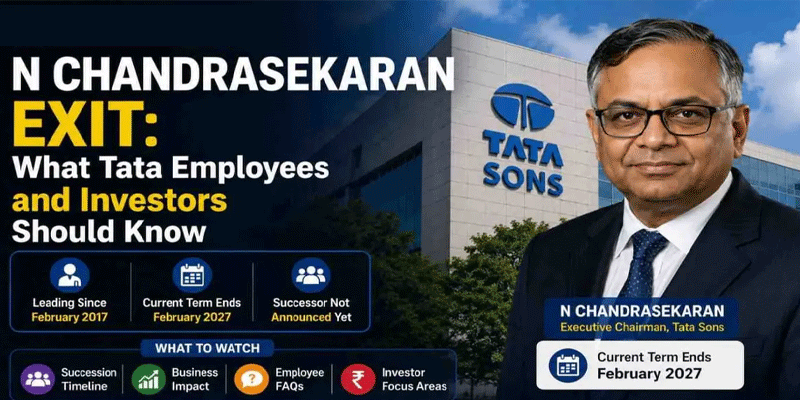
N Chandrasekaran has been re-appointed executive chairman of Tata Sons for another five-year term, reversing his decision last month not to seek a third term. The decision comes just months before his current tenure ends on February 20, 2027, and amid renewed regulatory pressure over Tata Sons’ ownership structure, listing status and governance.
A Sudden Reversal After Weeks of Uncertainty
Chandrasekaran, who became Tata Sons chairman in 2017, had told the board in August that he would not seek another term. His decision triggered questions about succession at a conglomerate simultaneously undertaking major investments in aviation, semiconductors, electronics, batteries, electric vehicles and digital businesses.
The reversal therefore goes beyond a routine extension. It indicates that the board has chosen continuity at a particularly complicated moment. Reports suggest that the earlier succession uncertainty was intertwined with differences involving Tata Trusts and the strategic direction of Tata Sons.
Why Has Tata Sons Reconsidered Its Leadership?
The immediate backdrop is regulatory. The Reserve Bank of India recently rejected Tata Sons’ request to surrender its Core Investment Company registration and directed it to comply with regulations applicable to upper-layer NBFCs. That decision has revived pressure for a public listing.
The listing question is particularly sensitive because:
· Tata Trusts controls about 66% of Tata Sons and has resisted the prospect of the holding company becoming publicly listed.
· Shapoorji Pallonji Group holds about 18.37% and has an interest in being able to monetise its stake.
· Tata Sons had already repaid more than ₹21,000 crore of debt while pursuing a route to exit the regulatory framework.
The RBI decision has therefore made succession inseparable from a much larger question: what should Tata Sons look like in the next phase?
Is Everything Really Fine Inside Tata?
The clearest indication that all differences have not disappeared is the reported vote of Noel Tata, chairman of Tata Trusts, against Chandrasekaran’s reappointment. Moneycontrol reported that Noel was the only board member to vote against the resolution.
However, the precise reason for his vote has not been publicly established. Reports have consistently linked Noel Tata’s position with opposition to Tata Sons becoming publicly listed and broader differences over governance and strategic direction. Before the meeting, he was reported to favour keeping Tata Sons private and seeking clarification from the RBI over its decision.
That means the vote should not automatically be interpreted as a personal rejection of Chandrasekaran. It more clearly demonstrates a substantive disagreement within the Tata ecosystem over the company’s future structure and governance.
Continuity Secured, Questions Remain
Chandrasekaran’s reappointment provides leadership stability, but it does not settle the underlying issues. Tata Sons now faces simultaneous challenges involving regulatory compliance, a possible listing, capital-intensive expansion and the relationship between its board and Tata Trusts.
The Extension May Delay, Not End, Tata’s Big Debate
The five-year extension gives Tata Sons an experienced leader while the group navigates an unusually complex transition. But Noel Tata’s dissent shows that consensus has not necessarily been restored. The coming period will reveal whether Chandrasekaran’s continuation becomes the foundation for a coordinated next chapter—or merely buys time before Tata Sons must confront its unresolved questions of ownership, listing, governance and succession.
(With agency inputs)