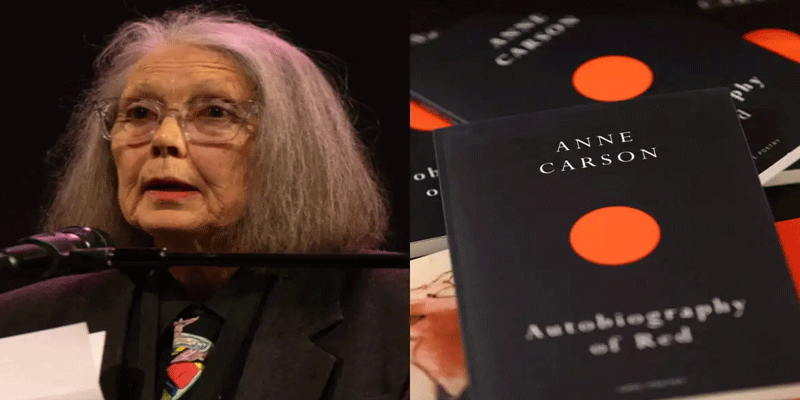
Canadian poet, essayist, classicist and translator Anne Carson has won the 2026 Nobel Prize in Literature, with the Swedish Academy recognising her “bold and inventive oeuvre” and her ability to create new forms through a creative dialogue with classical tradition. The announcement on October 8 places one of contemporary literature’s most unconventional voices at the centre of global attention.
From Classical Scholarship to Literary Innovation
Born in Toronto in 1950, Carson developed an early fascination with ancient Greek literature and language. She studied classics at the University of Toronto and pursued doctoral research at the University of St Andrews. Her academic training later became the foundation for a literary career that crossed the boundaries of poetry, scholarship, translation, drama and prose.
Her 1986 book Eros the Bittersweet established her reputation by examining desire in ancient Greek poetry and philosophy. Instead of treating classical literature as purely academic material, Carson transformed it into a source of contemporary literary exploration.
Her major works include Autobiography of Red, The Beauty of the Husband, Men in the Off Hours, Decreation, Red Doc and Nox. She has also translated and adapted Greek writers including Sappho, Euripides and Sophocles.
A Writer Who Refuses Literary Boundaries
Carson’s significance lies in the way she combines apparently different forms of writing. Poetry can sit beside scholarship, fragments can coexist with narrative, while translation can become an act of creative reinterpretation.
Her engagement with Greek mythology and classical texts is never simply an exercise in preservation. She brings ancient stories into conversations about love, grief, violence, gender, memory and human identity, making distant literary traditions feel contemporary.
The Nobel citation specifically recognises this experimentation, describing her work as a “playful dialogue with the classical tradition” that has created “new forms for contemporary literature.”
Why The Nobel Prize Matters
The Nobel Prize in Literature is among the world's most prestigious literary honours. Established through Alfred Nobel’s will and awarded since 1901, it recognises an author whose body of work is considered to have made an outstanding contribution to literature.
Beyond its medal, diploma and financial award, the prize can dramatically expand the international readership of a writer. The 2026 award carries 12 million Swedish kronor, while Carson succeeds Hungarian writer László Krasznahorkai, the 2025 laureate.
Carson’s selection is particularly significant because it celebrates not simply a popular novel or a single landmark publication, but an entire body of experimental work. It also highlights the continuing relevance of poetry, translation and classical scholarship within contemporary literature.
Global Attention on Carson’s Literary Legacy
The announcement immediately placed Carson’s works and distinctive literary method under renewed international scrutiny. Her Nobel recognition is likely to introduce new readers to books that challenge conventional distinctions between academic research and creative writing.
Her career demonstrates that ancient literature can remain relevant when it is not merely preserved, but questioned, reshaped and placed in dialogue with the present.
A Nobel That Connects Past and Future
Anne Carson’s Nobel Prize is ultimately a recognition of literary imagination without boundaries. By bringing classical voices into conversation with modern experience, she has demonstrated that the past can remain creatively alive.
Her honour sends a powerful message: great literature does not simply preserve tradition—it reinvents it for every new generation.
(With agency inputs)