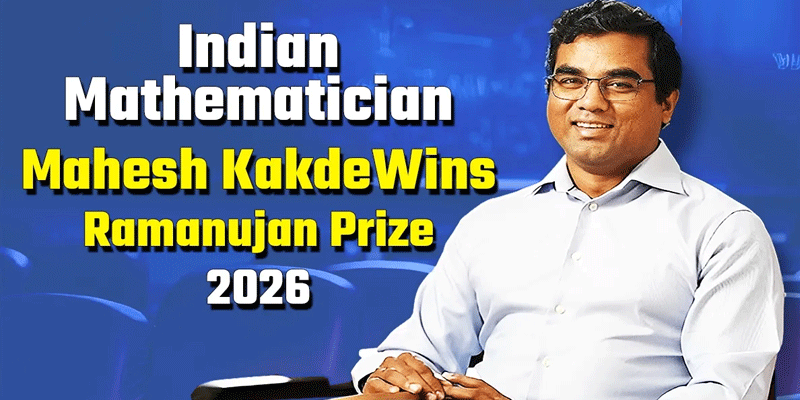
Professor Mahesh Kakde of the Indian Institute of Science (IISc), Bengaluru, has been awarded the 2026 Ramanujan Prize for Young Mathematicians from Developing Countries for his influential contributions to algebraic number theory. The prestigious honour recognises outstanding mathematicians under 45 working in developing countries and carries a cash prize of $10,000.
A Prize for Mathematical Excellence
Jointly administered by the International Centre for Theoretical Physics and the International Mathematical Union, the Ramanujan Prize honours young researchers whose work makes significant contributions to mathematics.
Kakde has been recognised particularly for fundamental advances in noncommutative Iwasawa theory and his work on the Gross–Stark and Brumer–Stark conjectures. Though highly specialised, these areas address profound questions about numbers, equations and the underlying structures governing arithmetic.
From Akola to the Global Mathematical Frontier
Born in Akola, Maharashtra, in 1983, Kakde studied mathematics at the Indian Statistical Institute in Bengaluru before moving to the University of Cambridge, where he completed his PhD in pure mathematics in 2008 under mathematician John Coates.
His academic journey subsequently took him to Princeton University, University College London and King’s College London, where he became a reader. He returned to India in 2019 as a professor at IISc, bringing international research experience back to one of the country’s leading scientific institutions.
Unravelling the Hidden Structures of Numbers
Kakde’s research centres on algebraic number theory, a field that explores the deeper arithmetic properties of number systems extending beyond ordinary integers and rational numbers.
One important area of his work is Iwasawa theory, which examines how arithmetic properties evolve through infinite towers of number fields. Kakde’s research combined sophisticated algebraic methods with techniques involving modular forms and p-adic analysis.
His contributions helped establish important relationships involving:
· p-adic L-functions;
· Class groups, which capture aspects of the arithmetic structure of number fields; and
· Units, the invertible elements within those number systems.
These connections provide powerful tools for understanding some of the most difficult questions in modern arithmetic.
Solving Deep Mathematical Conjectures
Working with Samit Dasgupta and Kevin Ventullo, Kakde contributed to the resolution of the Gross–Stark conjecture, which concerns special values and leading terms of p-adic L-functions.
His collaboration with Dasgupta also produced major advances on the Brumer–Stark conjecture, providing explicit information about units in abelian extensions of number fields.
The significance extends to questions connected with Hilbert’s 12th problem, one of the 23 landmark problems identified by mathematician David Hilbert in 1900. It seeks a systematic way to construct abelian extensions of number fields, linking number theory with fundamental questions of mathematical symmetry.
A Global Honour for India’s Mathematical Research
The Ramanujan Prize adds to Kakde’s distinguished record, which includes the Infosys Prize in Mathematical Sciences in 2022, the London Mathematical Society’s Whitehead Prize in 2023, and an invitation to speak at the 2022 International Congress of Mathematicians.
Pure Mathematics, Lasting Impact
Kakde’s recognition is not merely a personal achievement; it is also a powerful acknowledgement of India’s growing contribution to fundamental mathematical research.
His journey demonstrates that sustained investment in institutions such as IISc can enable Indian researchers to address questions at the very frontier of global mathematics—and that discoveries in pure mathematics can create intellectual foundations whose significance extends far beyond their immediate field.
(With agency inputs)