A Tour to Redefine America’s Footing in Asia
U.S. President Donald Trump’s sweeping Asia tour has captured global attention as he attempts to reassert American authority in a region increasingly defined by China’s economic reach and strategic confidence. Spanning Malaysia, Japan, and South Korea, the five-day journey serves as both a diplomatic outreach and a litmus test for Washington’s ability to rebuild trust and relevance. With domestic instability, a partial government shutdown, and slowing global trade looming in the background, Trump’s visit symbolizes an urgent bid to reclaim lost ground in one of the world’s most dynamic regions.
For many Asian leaders, this is not just about trade or security — it is about assessing whether the United States remains a dependable partner amid shifting geopolitical winds.
Kuala Lumpur: Diplomacy and Deals Amid Regional Friction
Malaysia marked the starting point of Trump’s ambitious itinerary, where he attended the ASEAN Summit in Kuala Lumpur. The U.S. sought to reframe itself as a stabilizing actor, particularly as Southeast Asia wrestles with internal disputes and China’s assertive posture in the South China Sea.
Trump’s first diplomatic achievement came quickly — brokering a peace accord between Thailand and Cambodia after months of border clashes. Hailing it as proof of his negotiation skills, the President underscored America’s role as a peacekeeper rather than a provocateur.
Alongside this, Trump and Malaysian Prime Minister Anwar Ibrahim announced a series of bilateral agreements covering semiconductor manufacturing, clean energy investments, and supply chain resilience. Both nations reaffirmed their commitment to freedom of navigation in the South China Sea — a pointed message directed at Beijing’s maritime ambitions.
Yet, behind the cordial smiles, Southeast Asian diplomats remained wary. While they welcomed U.S. engagement, they questioned whether Trump’s transactional style could translate into sustained partnership. As one regional observer put it, “Trump may bring attention, but not always assurance.”
Tokyo: A New Chapter with Japan’s First Female Prime Minister
From Kuala Lumpur, Trump headed to Tokyo for a landmark meeting with Prime Minister Sanae Takaichi, Japan’s first woman leader. Their discussions ushered in what both sides called a “new era” of U.S.–Japan relations. The two leaders finalized a sweeping $550 billion trade and investment deal focused on advanced technologies, renewable energy, and infrastructure — a package designed to rebalance economic ties strained by tariffs.
Trump praised Japan as “a cornerstone of peace and prosperity in Asia,” promising to sustain the U.S. military presence in the Pacific. Takaichi, known for her hawkish defense views, pledged closer cooperation under the Indo-Pacific Economic and Security Framework, aligning with Washington’s efforts to counterbalance China’s influence.
While Tokyo celebrated the deal as a sign of renewed partnership, analysts in Japan urged caution. Media outlets like Asahi Shimbun warned that overreliance on Trump’s unpredictable leadership could expose Japan to unnecessary risk. Still, Japanese strategists viewed the visit as pragmatic — a necessary step in maintaining equilibrium between U.S. security commitments and regional self-reliance.
Gyeongju: The Anticipated Trump–Xi Confrontation
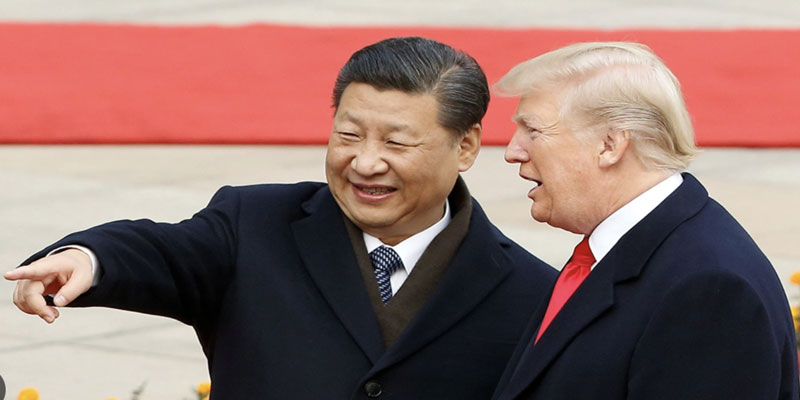
Trump’s final stop, South Korea, hosted the Asia-Pacific Economic Cooperation (APEC) Summit in Gyeongju — the stage for his much-anticipated meeting with Chinese President Xi Jinping. The encounter came amid escalating economic hostilities: Washington’s new sanctions on Chinese rare earth exports and Beijing’s retaliatory restrictions on critical minerals had reignited fears of another trade war.
Both leaders struck a cautious tone. The White House hinted at optimism for a “mutually beneficial deal,” while China’s Foreign Ministry framed the meeting as a dialogue rooted in “mutual respect, not concessions.” Despite this, few expected a major breakthrough. Topics ranging from Taiwan and North Korea to technology decoupling underscored the vast gulf between the two superpowers.
South Korea, acting as both host and mediator, sought to steer the talks toward economic stability and regional cooperation. Still, uncertainty lingered — especially for Seoul’s export-dependent industries vulnerable to the ripple effects of U.S.–China tensions.
Regional Reactions: Pragmatism with a Hint of Skepticism
Across Asia, reactions to Trump’s return to the diplomatic stage were mixed. In Southeast Asia, his participation in the ASEAN Summit was viewed as a welcome signal after years of American disengagement. Yet leaders like Malaysia’s Anwar Ibrahim and Vietnam’s officials quietly questioned Washington’s tariff-heavy trade posture. The prevailing sentiment was cautious optimism: nations appreciated U.S. involvement but refused to be drawn into choosing sides between Washington and Beijing.
In Japan, Trump’s visit was met with warmth but tempered restraint. The record trade deal was hailed as progress, though commentators emphasized Japan’s need for autonomy amid an uncertain U.S. foreign policy trajectory. Meanwhile, China maintained strategic composure, portraying Trump’s moves as part of a broader containment strategy while keeping diplomatic channels open.
Intriguingly, reports surfaced of preliminary talks between China, Japan, and South Korea to coordinate responses to potential future U.S. tariffs — an indication that regional powers are quietly preparing contingency plans independent of Washington’s whims.
The Balance Between Engagement and Endurance
Trump’s Asia tour may not have rewritten alliances overnight, but it has undeniably reenergized Washington’s presence in a region that has grown accustomed to American inconsistency. His diplomacy was bold, his promises grand, but his credibility remains a work in progress.
Asian nations, pragmatic as ever, are recalibrating their strategies — welcoming U.S. engagement while reinforcing regional autonomy. For them, Trump represents opportunity mixed with uncertainty: a partner capable of influence but prone to unpredictability.
Ultimately, whether this tour marks a true revival of American leadership or merely a passing spectacle will depend on what follows — consistency, clarity, and cooperation. For now, Asia listens, engages, and waits — watching closely as Washington tries once more to steady its hand in the world’s fastest-growing arena.
(With agency inputs)