Indian equities surge nearly 2% as falling crude prices, easing geopolitical concerns and foreign investor buying lift market sentiment.
Global financial markets have rallied following the Democrats' sweeping victory in the November 3, 2026 US midterm elections, with investors anticipating a possible de-escalation of the US-Iran conflict and a reduction in geopolitical uncertainty. The election outcome, which ended Republican control of both chambers of Congress, has raised expectations that President Donald Trump could face mounting political pressure to reconsider the war. The immediate beneficiary has been the crude oil market, with falling prices triggering renewed optimism across global equities, particularly in oil-importing economies such as India.
The Political Trigger: Why Markets Turned Bullish
Democrats secured control of both the House of Representatives and the Senate, significantly weakening Trump's legislative position for the remaining two years of his presidency.
Investors interpreted the result as a possible constraint on the administration's ability to continue its existing foreign-policy course without political resistance. Expectations of greater pressure for negotiations and an eventual end to the Iran conflict helped reduce the geopolitical risk premium in financial markets.
However, a divided Congress does not automatically guarantee an immediate ceasefire or diplomatic breakthrough. The rally reflects investor expectations rather than a confirmed change in the military situation.
Crude Oil Collapse: The Biggest Relief for Investors
Oil prices recorded a sharp decline following the election.
· Brent crude plunged 8.7% to $94.62 per barrel on November 4, its lowest level in two months.
· West Texas Intermediate (WTI) fell below $90 to approximately $88.57.
· On November 5 morning, Brent traded around $93.65, while WTI hovered near $86.98.
The decline is particularly significant for India, which imports a substantial proportion of its crude oil requirements.
Cheaper oil can reduce India's import bill, ease inflationary pressures, improve the current-account balance and lower operating costs for several industries. It also creates greater room for monetary-policy flexibility if inflation remains under control.
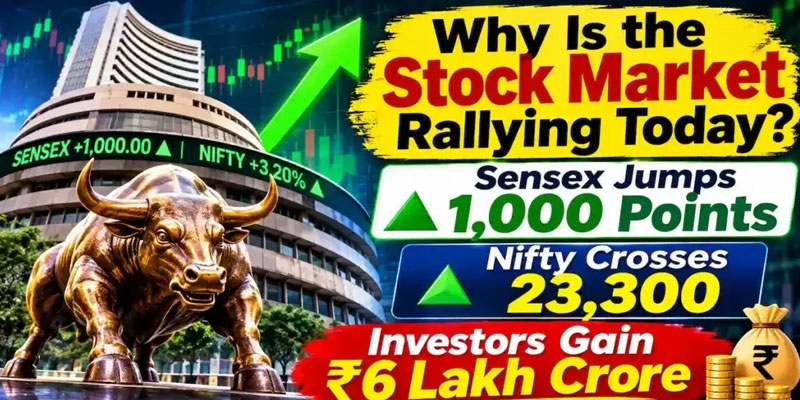
Indian Markets Rally Nearly 2%: Sensex Surges 1,600 Points
Indian equities opened sharply higher on November 5, tracking the positive sentiment across global markets following the US midterm election results and a significant decline in crude oil prices.
The key market movements were:
· Sensex: Opened at 78,910.94, gaining 1,609.54 points, or 2.08%.
· Nifty 50: Began trading at 24,378.05, up 417.45 points, or 1.74%.
· Intraday highs: Sensex touched 78,922.44, while Nifty climbed to 24,391.95.
· Market breadth: All 30 Sensex constituents traded in positive territory. On the NSE, 2,769 stocks advanced, 458 declined and 69 remained unchanged.
· Major gainers: IndiGo led the rally, rising 6.72%, while Asian Paints, HDFC Bank, Bajaj Finance and ICICI Bank also recorded strong gains.
· Further upward movement: By around 2 PM, the Sensex had climbed to 79,372.57, up 2,071.17 points or 2.68%. The Nifty advanced to 24,553.40, gaining 592.80 points or 2.47%.
The rally reflected improving investor confidence, supported by expectations of a possible easing of geopolitical tensions, softer crude prices and sustained foreign institutional investor buying. All 30 Sensex constituents traded in positive territory. Market breadth was equally encouraging, with 2,769 stocks advancing against 458 declining on the NSE.
Which Sectors and Stocks Benefited Most?
The rally extended across sectors, particularly those sensitive to crude prices, inflation and interest rates.
· IndiGo: Jumped 6.72%, benefiting from expectations of lower aviation turbine fuel costs.
· Asian Paints: Gained as cheaper crude-related inputs improved the outlook for operating margins.
· HDFC Bank and ICICI Bank: Advanced amid improving economic sentiment and expectations of stable inflation.
· Bajaj Finance: Benefited from renewed optimism towards financial and consumption-linked businesses.
Foreign institutional investors provided additional support, purchasing Indian equities worth ₹7,284 crore on November 4, marking their fourth consecutive session of net buying.
What Investors Must Watch Next
Despite the powerful rally, sustainability remains the key question. The immediate technical resistance zone for the Nifty was identified around 24,350–24,450, making its ability to sustain higher levels important.
Investors will closely monitor crude prices, developments in the Iran conflict, foreign institutional flows and India's inflation data.
A Relief Rally, But Geopolitics Holds the Key
The November 5 rally represents a combination of improving macroeconomic expectations and a reduction in geopolitical risk premiums. For India, sustained lower crude prices could provide meaningful relief to inflation, the external balance and corporate profitability. Nevertheless, markets may be getting ahead of diplomatic realities. Political pressure on Trump does not necessarily translate into an immediate end to the Iran conflict. The real test will be whether falling oil prices and improving global sentiment translate into a sustained economic recovery rather than a temporary market reaction. If crude remains relatively subdued and geopolitical tensions ease, Indian equities could retain their positive momentum. Any renewed escalation, however, could quickly reverse investor confidence and trigger fresh volatility.