A Strategic Shift Amid Global Turmoil
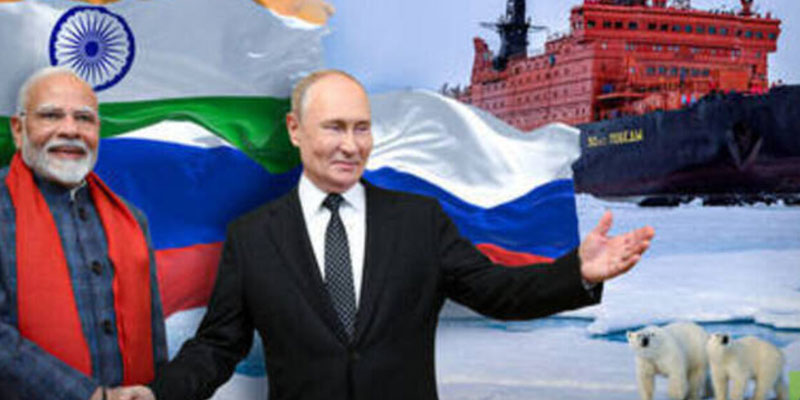
The growing Russian-Indian partnership in Arctic resource development is gaining traction against the backdrop of instability in West Asia. As the conflict disrupts traditional energy routes, both Russia and India are exploring new avenues to secure long-term economic and energy interests. While Moscow is accelerating efforts to monetise Arctic and Far Eastern resources, New Delhi is approaching the region cautiously—treating it as a strategic hedge rather than an immediate priority.
Arctic Wealth Meets India’s Cautious Strategy
Russia views the Arctic as a critical frontier for hydrocarbons, rare earths, and strategic minerals, alongside the development of the Northern Sea Route (NSR) as an alternative global shipping lane. For India, these resources align with its long-term needs, particularly as it seeks to diversify supply chains.
However, India’s engagement remains measured. Rather than directly investing heavily in Arctic extraction, it continues to rely on more accessible resources from Russia’s interior and Far East. Existing connectivity frameworks like the International North–South Transport Corridor (INSTC) and the Chennai–Vladivostok Maritime Corridor offer more immediate and cost-effective access to energy and raw materials.
The Chennai–Vladivostok route, in particular, is emerging as a key logistical link. By reducing transit time significantly compared to traditional routes, it strengthens trade in coal, timber, and minerals while indirectly connecting India to Arctic shipping networks. Collaborative initiatives such as training Indian seafarers for polar conditions and exploring ice-class vessel construction indicate a gradual, capability-driven approach.
Energy Security and the LNG Equation
The West Asia crisis has exposed vulnerabilities in global energy supply chains, especially for countries heavily dependent on Gulf routes. For India, a large share of crude oil and liquefied natural gas imports traditionally passes through the Strait of Hormuz, making disruptions a serious concern.
This has renewed interest in Russian energy supplies, particularly LNG. Recent discussions between Russian and Indian energy officials signal a potential revival of direct LNG exports from Russia to India. Such a move would diversify India’s energy basket and reduce reliance on volatile regions.
Yet, this shift is not without challenges. Arctic-linked LNG supply chains involve higher costs due to specialized shipping requirements and seasonal constraints of the NSR. Additionally, geopolitical factors and sanctions complicate pricing and logistics, potentially making such imports less competitive in the short term.
New Investment Pathways in the Far East
Russia’s introduction of International Advanced Development Zones (IADs) in its Far East from 2026 adds another dimension to the partnership. These zones offer long-term regulatory stability, tax incentives, and infrastructure support to attract foreign investment.
For India, they present structured opportunities in sectors such as pharmaceuticals, high-tech manufacturing, fertilizers, and mineral extraction. By aligning these investments with existing maritime corridors, India can integrate Far Eastern resources into its domestic economy more efficiently.
This approach allows India to benefit from Russia’s resource wealth without overcommitting to the high-risk Arctic environment, while still building a foothold for future expansion.
A Gradual but Strategic Realignment
The evolving Russia-India partnership reflects a pragmatic response to shifting global dynamics. While the Arctic holds immense potential, India’s strategy remains cautious and incremental, prioritizing immediate gains through established routes while preparing for long-term opportunities.
For Russia, collaboration with India offers a pathway to diversify markets amid geopolitical constraints. For India, it provides an alternative to unstable traditional energy corridors.
Ultimately, the Arctic may not yet be central to India’s strategy, but it is steadily moving from the periphery toward greater significance. As global uncertainties persist, this partnership could redefine how both nations navigate energy security, trade, and strategic influence in the years ahead.
(With agency inputs)