What’s ISI Cooking Up in Bangladesh?
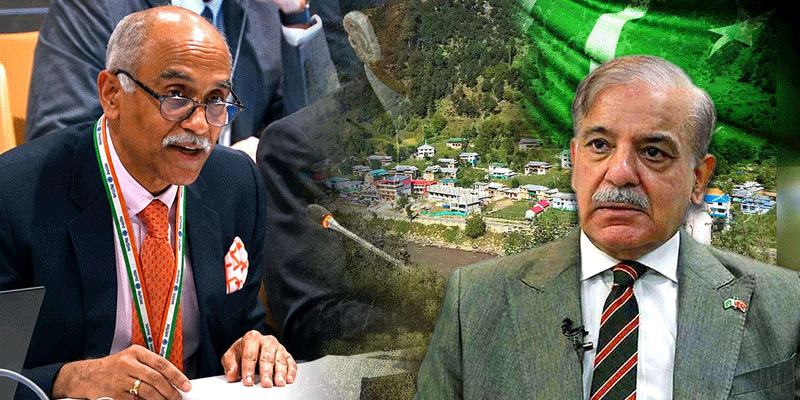
A six-member delegation of Bangladesh’s Directorate General of Forces Intelligence (DGFI), led by Colonel Magfuz-ul-Bari, visited Pakistan on August 15, 2026, signalling a notable deepening of military-intelligence engagement between Dhaka and Islamabad. The visit assumes added significance because it comes amid delicate India-Bangladesh diplomacy and questions over Prime Minister Tarique Rahman’s engagement with New Delhi. The development has prompted Indian strategic circles to closely watch whether Pakistan’s ISI is seeking a larger intelligence footprint in Bangladesh.
A Strategic Thaw Between Dhaka and Islamabad
Bangladesh-Pakistan relations have been undergoing a gradual reset following political changes in Dhaka. High-level military and intelligence exchanges have increased, including an earlier visit by DGFI chief Major General Qaiser Rashid Chowdhury to Islamabad in April.
Historically, Bangladesh maintained considerable distance from Pakistan because of the legacy of the 1971 Liberation War and its close strategic relationship with India. The current outreach represents a recalibration: Dhaka is seeking diversified external partnerships, while Islamabad sees an opportunity to regain influence in India's eastern neighbourhood.
Bangladesh’s Intelligence Outreach to Pakistan: Strategic Recalibration Amid India Tensions
The composition and timing of the DGFI delegation make the visit particularly significant. Indian reports interpret the engagement as part of Pakistan's effort to strengthen its links with Bangladesh's security establishment and potentially expand ISI influence in the region.
For India, the concern is not simply greater Bangladesh-Pakistan contact. Intelligence cooperation can have implications for border security, transnational crime, extremist networks, migration and activities affecting India's northeastern states.
At the same time, it would be premature to conclude that Dhaka has abandoned its traditionally multi-vector foreign policy. Bangladesh has strong economic, geographical and people-to-people connections with India, while maintaining expanding relations with China and other powers.
Tarique Rahman’s India Equation Adds Another Layer
The intelligence outreach coincides with uncertainty surrounding Tarique Rahman's proposed India engagement. New Delhi has separately invited him for a bilateral visit and invited him to the BRICS outreach session in September in his capacity as current BIMSTEC chair.
Dhaka has been reviewing the BRICS invitation, while bilateral irritants—including trade, water-sharing, visas and political issues—remain sensitive.
This creates an important diplomatic balancing act: Bangladesh can deepen ties with Pakistan while simultaneously negotiating with India, but excessive security cooperation with Islamabad could complicate efforts to rebuild trust with New Delhi.
What It Means for India
For India, the appropriate response is vigilance without overreaction. Bangladesh remains strategically vital because of the shared border, connectivity to the Northeast, Bay of Bengal security and extensive economic interdependence.
New Delhi should therefore strengthen intelligence coordination and border management while keeping diplomatic channels open. Economic cooperation, energy connectivity, trade facilitation and people-to-people relations can provide India with enduring strategic leverage.
India Must Watch, Engage and Adapt
The DGFI visit is an important signal, but not necessarily evidence of a permanent strategic shift. Pakistan may see Bangladesh as a new avenue for influence, while Dhaka may simply be widening its diplomatic options.
For India, the lesson is clear: neighbourhood influence cannot be sustained through geography alone. New Delhi must remain proactive, deepen trust with Dhaka and ensure that emerging Pakistan-Bangladesh security ties do not create strategic vulnerabilities along India's eastern frontier.
(With agency inputs)