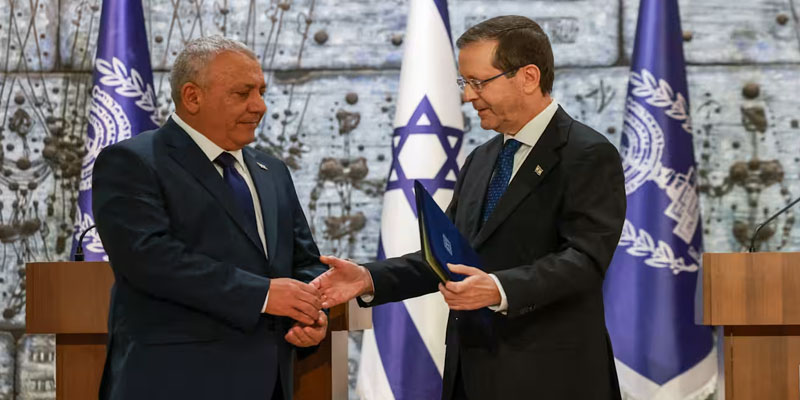
“Great urgency for new leadership,” declared Gadi Eisenkot after Israeli President Isaac Herzog formally entrusted him with the responsibility of forming the next government on November 8, 2026. The decision marks a significant political setback for incumbent Prime Minister Benjamin Netanyahu and opens a potentially historic chapter in Israeli politics. Backed by 67 members of the Knesset against Netanyahu’s 46, Eisenkot has emerged as the strongest contender to lead Israel. However, securing the mandate is only the beginning of a complicated political battle.
An Election Without a Clear Winner
Israel’s October 27 general election produced a fragmented 120-member Knesset, leaving the country without an immediately viable governing majority. Under Israel’s parliamentary system, the president consults elected political factions before assigning a lawmaker considered capable of forming a government.
Former Israel Defense Forces (IDF) chief of staff Gadi Eisenkot, leader of the centrist Yashar party, emerged as Netanyahu’s principal challenger. During consultations conducted by President Herzog, factions representing 67 lawmakers recommended Eisenkot, while 46 supported Netanyahu. The remaining seven lawmakers, belonging to the ultra-Orthodox United Torah Judaism party, declined to endorse either candidate.
Why Herzog’s Decision Matters
On November 8, Herzog formally handed Eisenkot the mandate to form the next government. The decision reflects the larger number of parliamentary recommendations supporting the opposition leader, although the president's responsibility also involves assessing whether a workable coalition can actually be assembled.
The Knesset requires at least 61 votes to establish a governing majority. Eisenkot's 67 recommendations therefore give him a numerical advantage, but they do not represent 67 guaranteed coalition partners.
Eisenkot has pledged to establish a broad national emergency government, arguing that Israel cannot afford prolonged political uncertainty or another cycle of elections. He has also appealed for cooperation across political divisions, including unconventional arrangements.
The Coalition Challenge: Numbers Versus Ideology
The biggest challenge is reconciling political groups whose ideological positions and policy priorities differ considerably.
Key complications include:
· Arab-led parties: Their 19 lawmakers provide potentially crucial parliamentary support, but cooperation with Arab-led factions remains unacceptable to some prospective coalition partners.
· Ultra-Orthodox parties: United Torah Judaism's seven seats could become decisive. However, disagreements over military-service exemptions complicate negotiations.
· Opposition divisions: Parties supporting Eisenkot may agree on replacing Netanyahu but differ over security, religion, governance and economic priorities.
· Likud's influence: Netanyahu's party remains a formidable political force, and he could attempt to attract undecided lawmakers or negotiate alternative arrangements.
These competing interests make a stable coalition considerably harder to achieve than the initial numbers suggest.
The Deadline and Israel's Security Concerns
Eisenkot has 28 days from receiving the mandate to assemble a government, with the possibility of an extension of up to 14 additional days from the president. The initial deadline is December 6.
The negotiations are unfolding amid continuing security challenges involving Iran, Gaza and Hezbollah, alongside wider regional uncertainties. Eisenkot's military background could strengthen his credibility on national security, but his immediate responsibility is to translate political support into a functioning administration.
Netanyahu, meanwhile, remains prime minister until a successor successfully forms a government. His 46 recommendations leave him behind, but do not eliminate his chances of returning to the coalition-building process if Eisenkot fails.
What Happens If Eisenkot Fails?
The immediate test is whether the 67 supporting lawmakers can be converted into binding coalition agreements. Eisenkot must negotiate ministerial positions, policy commitments and parliamentary support while preventing disagreements from dismantling his prospective alliance.
If he fails, Herzog can consider granting another lawmaker an opportunity to form a government. Renewed consultations and potentially another election remain possible.
A Defining Test for Israel's Political Future
Eisenkot's mandate represents more than a setback for Netanyahu; it signals a significant shift in Israel's political balance. Yet the transition is far from assured. The coming weeks will determine whether a diverse opposition can overcome ideological differences and establish a government capable of addressing Israel's security, economic and institutional challenges. Ultimately, the real test is not who commands the largest number of recommendations, but who can build a stable majority and restore public confidence in political leadership. Israel now faces a defining choice between continued political uncertainty and a potentially new direction in governance.
(With agency inputs)