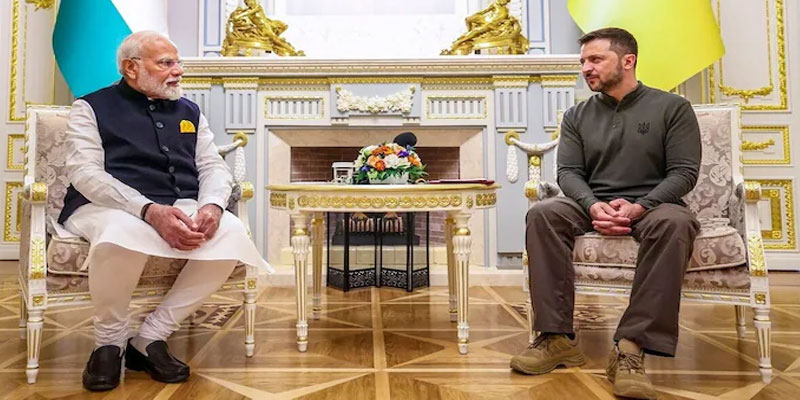
Prime Minister Narendra Modi and Ukrainian President Volodymyr Zelenskyy reviewed India-Ukraine bilateral ties during a telephone conversation on November 9, 2026, with the Russia-Ukraine war and prospects for peace dominating their discussions. Modi reiterated India's readiness to contribute to every effort towards a peaceful resolution, emphasising New Delhi's human-centric approach. The conversation came ahead of US-mediated negotiations in Abu Dhabi, with food security, maritime safety and uninterrupted grain shipments emerging as potential areas for India's diplomatic engagement.
India's Continued Push for Peace
Since the outbreak of the Russia-Ukraine conflict, India has consistently advocated dialogue and diplomacy rather than military confrontation. While maintaining its strategic partnership with Moscow, New Delhi has also sustained diplomatic engagement with Kyiv.
During the latest conversation, Zelenskyy briefed Modi on Ukraine's preparations for the Abu Dhabi discussions, where Russian and Ukrainian representatives were expected to address territorial differences and possible ceasefire-monitoring arrangements under US mediation. He also sought India's support in identifying practical channels for dialogue.
Food Corridors: A Humanitarian Priority
A major focus was the disruption of Ukrainian grain exports through the Black Sea, which has affected international food supplies and countries dependent on imported agricultural commodities. Zelenskyy highlighted the impact of restrictions on grain shipments and indicated that India could help facilitate humanitarian food corridors.
The proposal aims to ensure:
· Safe passage of Ukrainian grain shipments through the Black Sea.
· Protection of commercial vessels, ports and civilian crews.
· Continuity of international food trade without military interference.
Such an arrangement could offer immediate humanitarian relief without requiring Russia and Ukraine to resolve their larger territorial disputes.
Bilateral Cooperation and Parallel Diplomacy
The two leaders also reviewed bilateral cooperation and agreed to strengthen engagement across sectors for mutual benefit. Although no specific new agreements were announced, the conversation demonstrated India's intention to maintain constructive relations with Kyiv.
Significantly, the interaction followed External Affairs Minister S. Jaishankar's discussions with Russian Foreign Minister Sergey Lavrov. India's reported diplomatic approach includes ending attacks on energy and critical infrastructure, protecting merchant vessels and maintaining grain and energy shipments through Black Sea ports.
India's Balancing Act Between Moscow and Kyiv
India's diplomatic position is particularly significant because both sides recognise New Delhi's potential influence. Zelenskyy sees India as a possible facilitator of food corridors, while Russian President Vladimir Putin has acknowledged Modi's efforts to encourage a peaceful resolution.
However, India's balancing act requires considerable diplomatic sensitivity. It must uphold Ukraine's sovereignty and humanitarian concerns while preserving its longstanding strategic partnership with Russia. Its credibility depends on maintaining trust with both countries.
Abu Dhabi Talks: The Next Test for Peace
The immediate focus will be whether the US-mediated negotiations produce tangible outcomes on maritime security, grain movement, prisoner exchanges, ceasefire monitoring and protection of critical infrastructure.
Diplomacy Over Division: India's Opportunity to Make a Difference
India may not be in a position to independently end the war, but its diplomatic standing offers an opportunity to facilitate communication and practical humanitarian arrangements. A functioning Black Sea food corridor could become an important confidence-building measure. Modi's latest message reinforces India's preference for dialogue, de-escalation and a negotiated settlement, positioning New Delhi as a constructive voice in the search for lasting peace.
(With agency inputs)