Nearly 3,000 Government Schools Function Without Buildings
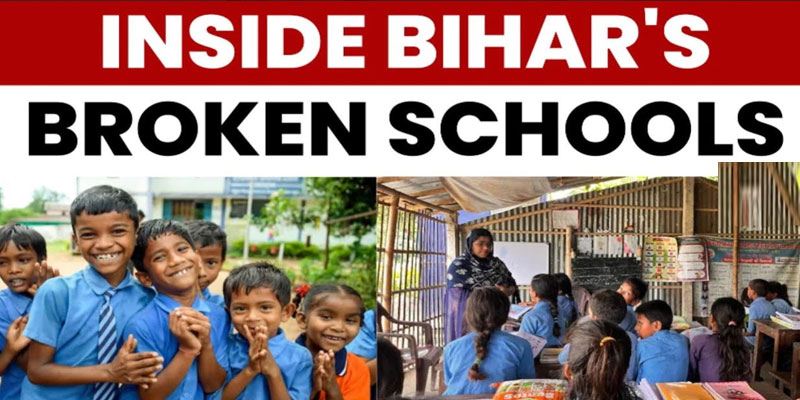
A startling disclosure during the Bihar Legislative Assembly's Monsoon Session has once again exposed the deep infrastructure challenges confronting the state's education system. According to UDISE+ 2025-26 data tabled in the House, 2,996 government schools across Bihar are functioning without their own buildings, forcing thousands of students to study in rented premises, community halls, shared campuses and temporary structures. The revelation has intensified concerns over the quality of education, student safety and the state's ability to provide equitable learning opportunities despite substantial budgetary allocations.
Understanding the Scale of the Crisis
The Assembly data paints a grim picture of Bihar's school infrastructure.
Of the total schools without permanent buildings:
· 2,276 primary, middle and secondary schools spread across 35 districts lack dedicated campuses.
· 720 higher secondary (Plus-Two) schools across 34 districts are also operating without their own buildings, out of the state's total 9,297 higher secondary schools.
Many institutions continue to function from borrowed classrooms, rented buildings, panchayat halls and makeshift facilities. In several cases, schools do not even possess land on which permanent buildings can be constructed.
The findings underscore a long-standing infrastructure deficit that continues to affect thousands of children across rural and semi-urban Bihar.
Why Do So Many Schools Lack Buildings?
One of the biggest hurdles has been land acquisition. Numerous schools were established on donated or encroached land without clear ownership documents, making them ineligible for government-funded construction projects. Many institutions upgraded from primary to higher secondary levels also failed to secure additional land, resulting in overcrowded classrooms and temporary arrangements.
Project execution has posed another challenge. Although Bihar allocated nearly 21.7% of its 2025-26 Budget to education, infrastructure projects have often been delayed due to slow procurement processes, contractor inefficiencies and governance issues. The Bihar State Educational Infrastructure Development Corporation (BSEIDC), responsible for constructing school buildings, has faced criticism over delayed implementation.
Rapid expansion of the school network over the past decade further widened the infrastructure gap. While access to education improved, physical facilities did not keep pace with growing enrolment and institutional upgrades.
Government Response and Wider Infrastructure Gaps
Chief Minister Samrat Choudhary announced that land would be provided to all government schools lacking permanent campuses within six months, a commitment that will now be closely monitored.
However, the building shortage is only one aspect of Bihar's educational infrastructure challenge.
Official data also indicates that thousands of schools continue to lack:
· Safe drinking water facilities.
· Electricity connections.
· Functional toilets, particularly for girls.
· Libraries and computer laboratories.
· Playgrounds and recreational spaces.
These deficiencies directly affect attendance, learning outcomes, teacher retention and the overall quality of education, particularly in rural and economically weaker regions.
A Test of Governance and Educational Equity
The disclosure raises important questions about governance, planning and policy execution. Schools without proper buildings disproportionately affect children from disadvantaged communities, limiting their access to safe and effective learning environments.
The government's promise to allocate land within six months offers hope, but success will depend on timely land identification, transparent implementation, efficient fund utilisation and sustained monitoring. Addressing Bihar's school infrastructure deficit is not merely about constructing buildings—it is about safeguarding the constitutional promise of quality education. Unless backed by swift execution and long-term planning, thousands of students will continue to pursue their education under inadequate conditions, delaying the state's broader aspirations of educational equity and human development.
(With agency inputs)