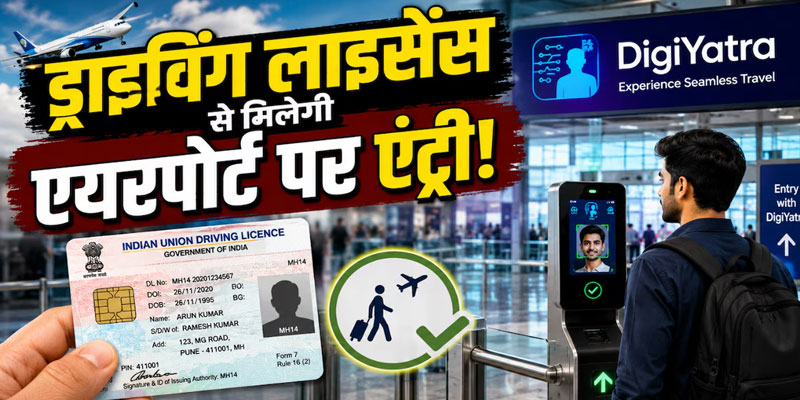
Digi Yatra's decision to add the Driving Licence as a verified digital identity credential marks an important expansion of India's contactless airport travel ecosystem. With the latest update, passengers can now enroll using either Aadhaar or a Driving Licence (via DigiLocker), and those who have both credentials can choose either as their primary identity for airport verification.
At first glance, some may ask whether this change reflects declining trust in Aadhaar. However, there is no evidence that this is the reason. In fact, Digi Yatra has always been designed around the concept of accepting multiple government-approved identity documents rather than making Aadhaar the only option. Earlier policy documents also envisaged support for Driving Licence, Passport, Voter ID, PAN, and other government-issued IDs, with different verification methods depending on the document used.
The more likely explanation is that the move is intended to increase accessibility, user choice, and adoption. Not every traveler wishes to use Aadhaar for enrollment, and some users face practical issues such as name mismatches between Aadhaar and airline tickets or simply prefer using another government-issued credential. By expanding the range of accepted IDs, Digi Yatra lowers barriers to adoption while maintaining its facial-recognition-based travel experience.
The bigger story is not whether Aadhaar is being replaced—it is that digital identity is evolving toward a multi-credential model. Modern identity systems increasingly rely on multiple trusted credentials combined with biometrics, rather than a single document. This approach improves resilience, enhances user convenience, and provides flexibility while reducing dependence on any one identity source.
As AI-driven identity fraud, deepfakes, synthetic identities, and document forgery continue to grow, the next phase of digital identity will likely move beyond document verification alone. Future identity platforms will increasingly combine government-issued credentials with facial liveness detection, behavioral biometrics, device intelligence, continuous authentication, and explainable AI to verify not only the document but also the human behind it.
For India's digital ecosystem, Digi Yatra's latest update should therefore be viewed less as a statement about Aadhaar and more as an evolution toward identity choice, interoperability, and stronger digital trust in an increasingly AI-powered world.