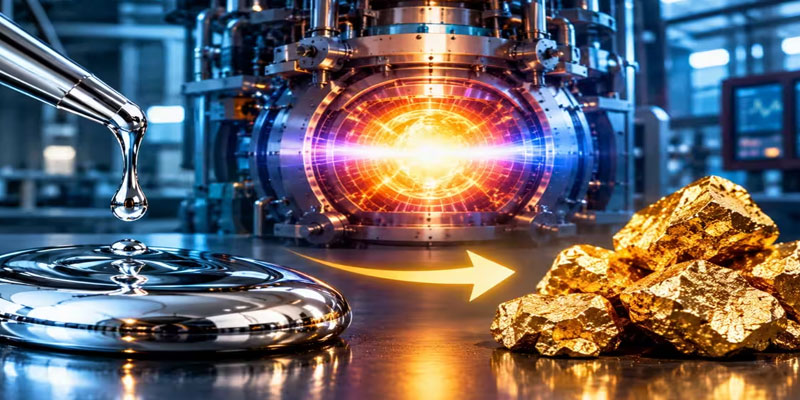
A groundbreaking scientific claim by American startup Marathon Fusion has sparked global curiosity about the future of gold prices. The San Francisco-based company says it has successfully converted mercury into stable gold using nuclear fusion technology, potentially challenging the centuries-old perception of gold as an exceptionally scarce precious metal.
On October 21, 2026, Marathon Fusion announced that its experimental process achieved a gold-production rate reportedly ten times higher than a benchmark established by CERN. However, the company has not disclosed the actual quantity produced, and independent scientific verification remains pending.
The technology relies on nuclear transmutation, where high-energy neutrons interact with mercury-198, converting it into radioactive mercury-197. This subsequently decays into gold-197, the stable isotope found in naturally occurring gold. Unlike conventional chemistry, nuclear reactions can fundamentally transform one element into another.
The development raises an intriguing economic question: could artificially manufactured gold eventually disrupt global bullion markets? If commercial fusion reactors begin producing significant quantities, additional supply could weaken gold's scarcity premium, potentially exerting downward pressure on prices over the longer term.
However, substantial technological and financial barriers remain. Commercial fusion power generation is still unproven, while isotope separation, radioactive byproduct management, processing costs and operational complexity present formidable challenges. Producing laboratory gold economically at industrial scale remains far from reality.
The implications extend beyond jewellery and investment markets. Central banks, including the Reserve Bank of India, hold gold as a strategic reserve asset. Any fundamental transformation in global supply could eventually influence reserve valuations, commodity markets and investor confidence. Nevertheless, monetary policy, geopolitical uncertainty and investment demand remain stronger immediate price drivers.
Ultimately, Marathon Fusion's announcement represents a fascinating intersection of nuclear science, DeepTech innovation and commodity economics. While laboratory-created gold may someday challenge traditional mining economics, an immediate collapse in gold prices appears unlikely. The real revolution will begin only when scientists can manufacture gold more economically than miners can extract it.