France faced another major day of high-school blockades and trade union-backed demonstrations on Tuesday, as students demanded urgent action over teacher shortages, overcrowded classrooms and deteriorating school infrastructure. What began in disadvantaged suburbs around Paris has spread nationwide, turning education into a broader political and fiscal challenge for Prime Minister Sebastien Lecornu’s government.
From School Grievances to National Protest
The movement emerged from longstanding complaints about inadequate staffing and declining school conditions, particularly in poorer communities. Students are demanding replacement teachers for absent staff, manageable school schedules, longer lunch breaks, more nurses and social workers, and repairs to ageing buildings.
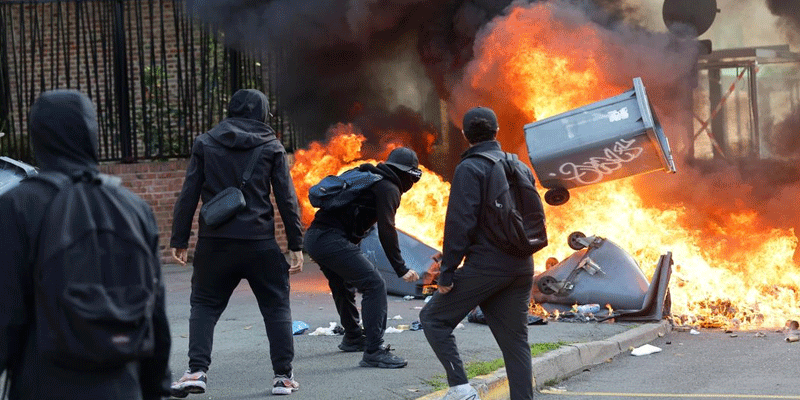
The protests have expanded from the Paris region to cities including Lille, Marseille, Strasbourg and Nantes. On Tuesday, students used rubbish bins to blockade school entrances, while trade unions joined demonstrations in support of wider public-service demands.
The scale of disruption has grown rapidly. Earlier in the week, hundreds of schools were affected, while Reuters reported that the broader movement had reached more than 1,200 high schools during the preceding days.
Violence Raises Stakes
While many demonstrations have centred on education, some confrontations have become violent, involving fires, vandalism and clashes with police. Authorities have responded with riot-control measures, including tear gas and other crowd-control weapons.
Tensions intensified after a 15-year-old boy lost his hand in Lens during Monday’s unrest. Local authorities confirmed an investigation, while La Voix du Nord reported that the teenager was injured after picking up a police dispersal grenade.
The incident has added to criticism over the policing of protests involving minors, while authorities argue that violence and attacks on police cannot be tolerated.
Government Promises Action Amid Budget Pressure
Lecornu has ordered ministers to prepare proposals by the end of October addressing key student demands, including teacher replacements, school hours and repairs to ageing facilities.
But delivering those measures presents a difficult financial challenge. France’s 2027 budget seeks major savings as the government attempts to reduce its deficit. The country’s debt has reached about 119% of economic output, while borrowing costs have risen sharply, with the 10-year bond yield recently moving above 5%.
Education spending is planned to rise by 1.7%, to €65.53 billion excluding teacher pensions, but that increase remains below inflation.
Arrests and Political Tensions Mount
The unrest has also produced a substantial law-and-order response. According to the prime minister’s office, at least 5,060 people have been arrested, 87% of them minors, while 715 police officers and 215 teenagers have been injured.
The crisis has acquired an increasingly political dimension ahead of France’s 2027 presidential election. The government and the far-right National Rally have accused the hard-left France Unbowed of encouraging disorder, an allegation the party rejects.
Education Crisis Meets Fiscal Reality
France’s school protests now represent more than a dispute over classrooms and teachers. They expose the difficult balance between maintaining essential public services and restoring strained public finances.
The government’s response will have to address legitimate concerns over educational conditions while containing violence and respecting fiscal constraints. Whether Lecornu can convert promised measures into visible improvements may determine whether the protests subside or become a wider confrontation over austerity, public services and France’s political direction.
(With agency inputs)