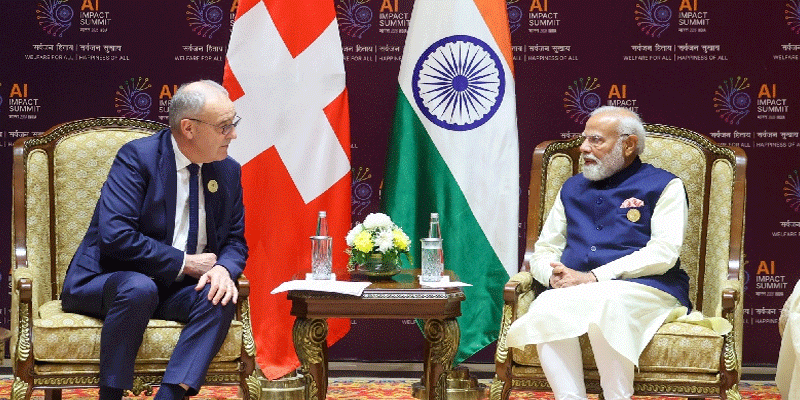
Prime Minister Narendra Modi and Swiss President Guy Parmelin held bilateral talks at Hyderabad House in New Delhi, focusing on ways to deepen an already strong partnership. The discussions come at an important moment, with the India–EFTA trade agreement entering its second year and both countries looking to translate its framework into greater economic and technological cooperation.
A Partnership Built on Strong Foundations
India and Switzerland have developed a stable relationship centred on trade, investment, science, technology and people-to-people connections. Switzerland has a significant presence in India's pharmaceutical, chemical, machinery, financial and luxury sectors, while Indian companies increasingly view Switzerland as an important European gateway.
The agreement covers tariff liberalisation, investment, regulatory cooperation and mobility. Switzerland and other EFTA members have also committed to facilitating substantial investment in India, including a collective target of $100 billion over 15 years.
Parmelin's Three-Day India Visit
Parmelin began his three-day state visit to India on October 5 at Modi's invitation. Following a ceremonial reception at Rashtrapati Bhavan, he met Modi at Hyderabad House for detailed bilateral discussions.
External Affairs Minister S. Jaishankar also met the Swiss President, reinforcing the importance attached to the visit.
The timing is significant as India and EFTA prepare to mark the first anniversary of TEPA's implementation. Parmelin is scheduled to participate in the second India–EFTA Prosperity Summit on October 7, alongside representatives of Iceland, Liechtenstein and Norway.
Trade, Technology and Mobility Take Centre Stage
The discussions between Modi and Parmelin covered a broad strategic agenda, with particular attention to converting existing agreements into measurable outcomes.
Key areas included:
· Trade and investment: Reviewing TEPA's implementation, improving market access and accelerating investment commitments.
· Technology and innovation: Expanding cooperation in advanced manufacturing, life sciences, clean energy and digital technologies.
· Skills and mobility: Facilitating movement of professionals, students and researchers while strengthening skill-development partnerships.
· Global cooperation: Exchanging perspectives on regional developments, climate action and multilateral issues.
The emphasis is increasingly shifting from signing agreements to ensuring their effective implementation through regulatory coordination, faster clearances and sector-specific partnerships.
From Agreements to Tangible Economic Gains
Modi and Parmelin's meeting reflects an effort to give greater strategic and economic depth to India–Switzerland relations. With TEPA providing the institutional foundation, the next phase will depend on how effectively both sides convert commitments into investment, jobs, technology partnerships and easier market access.
The broader message is clear: India and Switzerland are seeking not merely stronger diplomatic ties, but a more productive economic partnership capable of delivering visible results.
(With agency inputs)