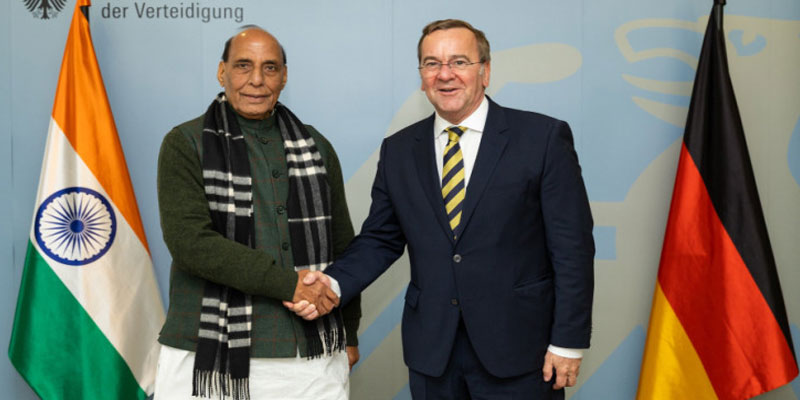
Rajnath Singh has invited German industry leaders to co-develop advanced defence technologies with India, positioning the country as a long-term strategic partner in a rapidly shifting global security landscape.
A Strategic Pitch in Munich
Speaking at a defence investor gathering in Munich, Singh framed India not as a transactional arms market but as a reliable, long-term collaborator. His message was clear: partnerships rooted in trust, shared interests, and technological synergy are essential in an era marked by geopolitical uncertainty and supply chain disruptions. By reaching out directly to German firms, India is signaling its intent to deepen ties with Europe while diversifying defence partnerships beyond traditional alignments.
India’s Value Proposition to German Industry
Singh’s pitch highlighted India’s growing appeal as a defence manufacturing hub. He pointed to a large domestic demand base, a young and skilled workforce, improving infrastructure, and a stable regulatory environment backed by rule of law. These factors, he argued, make India uniquely positioned for long-term industrial collaboration.
Crucially, the emphasis was on shifting perception—from India as a buyer of defence equipment to a co-creator of advanced technologies. This aligns with the evolving priorities of German companies seeking resilient and diversified supply chains amid global uncertainties.
Focus on High-End Defence Technologies
The collaboration is not limited to conventional manufacturing but extends to cutting-edge domains. Singh identified several priority areas, including advanced radar and sensor systems, artificial intelligence-driven unmanned platforms, and underwater technologies such as sonar and communication systems.
These sectors are strategically significant, particularly in naval and sub-sea capabilities. One notable example is the potential involvement of ThyssenKrupp Marine Systems in India’s multi-billion-dollar conventional submarine programme. Such projects illustrate how Indo-German cooperation could evolve into deep technological partnerships rather than simple procurement deals.
Redefining ‘Aatmanirbhar Bharat’
A key aspect of Singh’s address was reframing the concept of Aatmanirbhar Bharat. He emphasized that self-reliance does not equate to isolationism. Instead, it is about building domestic capabilities through collaboration with trusted global partners.
By encouraging German firms to invest in research, design, and production within India, the initiative aims to create a mutually beneficial ecosystem. This approach challenges the traditional model where advanced economies dominate innovation while others remain dependent on imports.
Geopolitical Context and Strategic Alignment
The outreach comes at a time when global powers are reassessing dependencies in defence and technology supply chains. For Germany, engaging with India offers access to a large market and a stable partner in the Indo-Pacific region. For India, closer ties with European nations strengthen its strategic autonomy and reduce reliance on any single bloc.
This alignment also reflects a broader trend of like-minded democracies collaborating on security and technological resilience in an increasingly competitive global environment.
Toward a Collaborative Defence Future
Rajnath Singh’s invitation marks a significant step in redefining India’s role in the global defence ecosystem. By promoting co-development and co-production, India is positioning itself as a partner rather than a customer. If successfully implemented, this strategy could transform the country’s defence industry, foster innovation, and build enduring strategic ties with nations like Germany. In a world of shifting alliances, such collaborations may prove essential for both security and economic resilience.
(With agency inputs)