A Major Financial Push for Nepal's Recovery and Growth
India has announced a landmark development assistance package worth $1.62 billion (NPR 24,000 crore) for Nepal, making it one of its largest financial commitments to the Himalayan neighbour. The announcement came during Nepali Prime Minister Balendra Shah's first state visit to India on November 22–23, 2026, following talks with Prime Minister Narendra Modi in New Delhi. The package combines immediate post-flood reconstruction assistance with long-term investments in energy, infrastructure, trade, education and regional connectivity. The visit signals India's intention to strengthen its neighbourhood partnership through tangible economic cooperation.
Historical Ties and the Changing Regional Landscape
India and Nepal share centuries-old cultural, religious, economic and people-to-people connections. Their open border, geographical proximity and interconnected economies make the relationship particularly important. India is among Nepal's largest trading partners and a major source of essential supplies, investment and development assistance.
However, bilateral relations have periodically encountered difficulties over territorial disputes, political differences and Nepal's growing engagement with China. The August 2026 floods further exposed Nepal's infrastructure vulnerabilities, causing extensive destruction and disrupting transport links. Estimates placed the economic damage at nearly $5 billion.
Against this background, Shah's visit offered an opportunity to rebuild confidence and establish a forward-looking partnership.
Breaking Down Modi's $1.62 Billion Package
Modi announced assistance of NPR 24,000 crore, equivalent to approximately INR 15,000 crore. The package has two major components:
· Grant assistance: INR 3,500 crore (NPR 5,600 crore) for post-disaster reconstruction and new infrastructure projects.
· Line of Credit: INR 11,500 crore (NPR 18,400 crore), denominated in Indian rupees, for energy-sector projects.
He also described India's support as unwavering, emphasising that the relationship is rooted not merely in geographical proximity but in mutual trust and shared progress.
Energy, Trade and Connectivity Take Centre Stage
Energy cooperation emerged as a major pillar of the discussions. Both countries are looking to expand electricity trade, develop cross-border transmission infrastructure and strengthen petroleum connectivity. India also welcomed progress on two high-capacity transmission-line projects linking Nepal with New Purnea and Bareilly.
Important announcements included:
· Port connectivity: Nepal will gain a new transit-trade route through Deendayal Port at Kandla, Gujarat, with Paradip Port in Odisha also identified for future access.
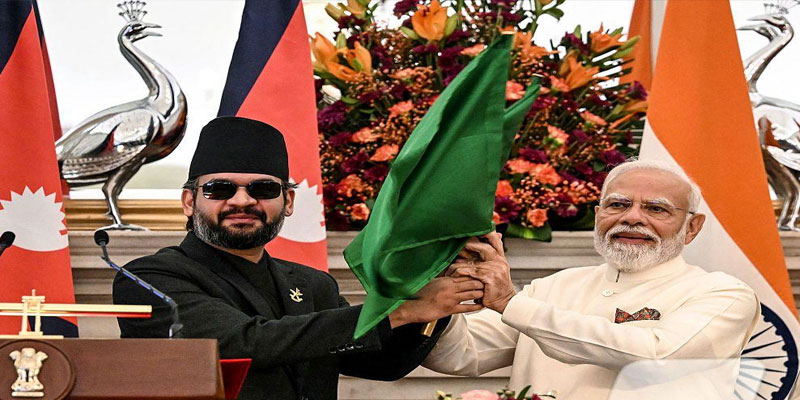
· Rail connectivity: The leaders inaugurated a passenger train service connecting Ayodhya and Janakpur, strengthening religious tourism and cross-border mobility.
· Education: India will establish an offshore IIT campus in Nepal, expanding access to advanced technical education.
· Economic cooperation: Both sides will explore industrial parks, investment opportunities, digital infrastructure and startup partnerships.
Modi's Message and Shah's Response
Modi welcomed Shah's vision for Nepal's development and said he had witnessed his commitment to taking bilateral relations to new heights. He emphasised that India's relationship with Nepal was built on shared history, faith, culture and enduring trust.
The two leaders adopted the joint vision document, Viksit Bharat and Samunnat Nepal, covering economic development, climate resilience, disaster management, innovation, digital services, space technology and youth exchanges.
Shah described India as a dependable and trusted neighbour, thanking its government and people for humanitarian assistance during Nepal's recent floods. He also invited Indian investors to participate in Nepal's economic transformation.
A Strategic Partnership Must Deliver Results
The $1.62-billion commitment represents more than financial assistance. It reinforces India's Neighbourhood First policy while strengthening its economic and strategic engagement with a country that occupies an important position between India and China.
For Nepal, the package offers reconstruction support, improved access to international trade routes, energy investment and educational opportunities. For India, stronger infrastructure and economic integration with Nepal can create a more resilient regional partnership.
The real measure of this diplomatic success will be execution, not announcements. If both governments translate their commitments into completed projects, reliable energy networks and stronger trade, this visit could mark a significant new chapter in India-Nepal relations.
(With agency inputs)