Muhammad Yunus Aide's 'Northeast' Provocation After Pahalgam Attack
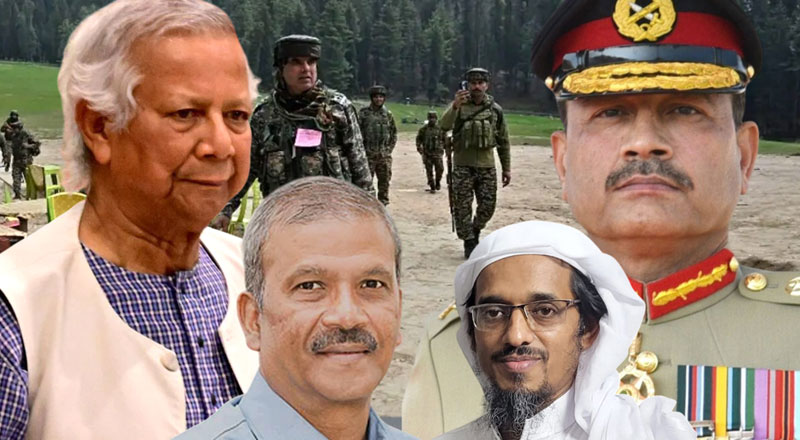
A controversial Facebook post by retired Bangladeshi Major General ALM Fazlur Rahman has stirred diplomatic tensions between India and Bangladesh at a sensitive time. Reacting to the recent terror attack in Pahalgam, Jammu and Kashmir—which killed 26 people—Rahman suggested that if India retaliates against Pakistan, Bangladesh should occupy India’s entire northeast. Even more provocatively, he called for military cooperation with China to accomplish this strategic goal.
Rahman, a former head of Bangladesh Rifles (now Border Guard Bangladesh), is widely seen as politically aligned with Muhammad Yunus, Bangladesh's chief advisor. His inflammatory suggestion arrives amid efforts by both New Delhi and Dhaka to repair a strained relationship following recent political shifts and growing friction over minority rights, cross-border movements, and regional influence.
Context: Dhaka’s Shifting Dynamics and Pakistan Linkages
Bangladesh’s internal political currents have become increasingly turbulent. The return of Nobel laureate Muhammad Yunus as chief advisor after the ouster of long-time Prime Minister Sheikh Hasina marked a significant political realignment. Yunus, admired internationally for his work in microfinance, has taken a more assertive and, at times, geopolitically provocative stance in foreign policy discourse.
In recent months, Yunus’s perceived overtures toward Pakistan and China have not gone unnoticed. His remarks during a March visit to Beijing about India’s northeastern states—referring to them as "landlocked and dependent" and calling Bangladesh the “only guardian of the ocean”—raised red flags in Indian diplomatic circles. The statement, cloaked in economic cooperation rhetoric, was seen as implicitly supporting China’s strategic interests in the region and undermining India’s regional position.
Meanwhile, reports of targeted attacks on Hindu minorities and the political asylum granted to Sheikh Hasina in India have further complicated bilateral relations. Against this backdrop, Rahman's rhetoric has been interpreted as more than just an isolated expression of military bravado—it reflects an underlying regional recalibration that India views with concern.
India Responds: Strategic Pushback from Modi Government
The response from India has been measured but firm. Prime Minister Narendra Modi has reportedly communicated, both directly and through diplomatic channels, his government's strong objection to Rahman's statement and Yunus's earlier comments. According to senior government sources, Modi’s message was clear: such threats, however theoretical, risk crossing a red line in regional diplomacy and will not be tolerated.
India’s Ministry of External Affairs, under S. Jaishankar, subtly responded during a BIMSTEC meeting in April by asserting the strategic significance of India’s northeast. “Our northeastern region... is emerging as a connectivity hub,” Jaishankar said, underscoring India’s vision of inclusive regional growth and connectivity—a pointed contrast to Yunus’s “landlocked” narrative.
Further, India has acted on the economic front. It revoked a long-standing arrangement that allowed Bangladeshi export cargo to be transshipped via Indian ports and airports. While officially attributed to logistical congestion, the move is widely viewed as a calibrated signal of India’s readiness to use trade leverage to counter hostile posturing.
Strategic Analysis: Echoes of a Larger Power Game
Rahman’s proposal, implausible though it may sound militarily, reflects deeper anxieties and ambitions shaping the subcontinent’s future. China’s rising influence in South Asia—through the Belt and Road Initiative and maritime infrastructure investments—has emboldened certain factions in Bangladesh to imagine alternatives to traditional regional hierarchies.
Yunus’s geopolitical language aligns strikingly with China’s regional playbook: leveraging economic dependency to secure political alignment and access. Bangladesh’s geographic positioning between India’s vulnerable northeast and the Bay of Bengal makes it a focal point in this emerging triangle of competition between India, China, and Pakistan.
The concern in Delhi is not about a literal invasion, but the strategic entrapment of India’s northeastern states through economic encirclement and diplomatic isolation—concepts India is keenly aware of from its past experiences in South Asia.
Time for Restraint, Not Recklessness
This latest flare-up between India and Bangladesh is a stark reminder of how quickly rhetoric—especially from influential military or political actors—can destabilize regional peace. At a time when South Asia faces overlapping crises from economic fragility to climate vulnerability, leaders must exercise restraint and foresight, not indulge in reckless provocations or proxy ambitions.
Rahman's remarks, while officially disavowed, have done enough damage by fanning mistrust and feeding strategic anxieties. If Bangladesh under Yunus is to maintain credibility on the global stage, it must clarify its strategic intentions and distance itself from warmongering voices. At the same time, India’s response must continue to balance firmness with engagement—strengthening alliances, defending its interests, but leaving space open for dialogue.
In a region haunted by the ghosts of partition, territorial rhetoric is not a game. The future of South Asia lies not in drawing new battle lines, but in dismantling old ones—economically, diplomatically, and culturally.
(With inputs from agencies)