A Routine Training Sortie Turns Fatal
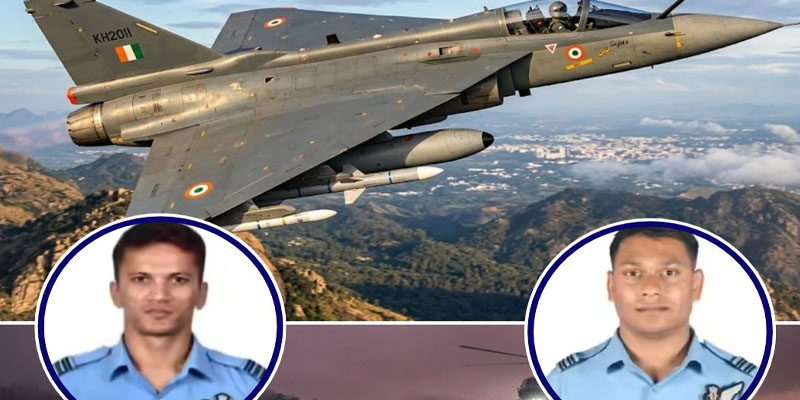
An Indian Air Force Sukhoi Su‑30MKI fighter jet crashed in Assam’s Karbi Anglong district during a routine training mission shortly after taking off from Jorhat Airbase, turning a standard operational sortie into a tragic accident. The twin-engine aircraft lost radar contact minutes after departure on the evening of March 5, 2026, prompting an urgent search and rescue effort in the remote, forested hills of the region.
Fatalities Confirmed After Overnight Search
The Indian Air Force later confirmed that both pilots onboard—Squadron Leader Anuj and Flight Lieutenant Purvesh Duragkar—succumbed to fatal injuries in the crash. The aircraft had taken off from Jorhat Air Force Station at approximately 7:42 pm before losing radar contact.
The jet eventually crashed in a remote area of Karbi Anglong, around 60 kilometres from Jorhat. Local residents reported hearing a loud explosion followed by a large fireball, suggesting the aircraft impacted the ground at high speed.
Rescue teams faced considerable challenges navigating dense forests and hilly terrain through the night. By early Friday morning, personnel reached the wreckage and confirmed the deaths of both pilots. Authorities stated that there were no reports of civilian casualties or damage on the ground.
The Su-30MKI: Backbone of India’s Air Combat Fleet
The Sukhoi Su‑30MKI is one of the most powerful multirole fighter aircraft in service with the Indian Air Force. With more than 260 aircraft operational, it forms the backbone of India’s combat aviation capability.
Powered by Saturn AL‑31FP engines, the jet is known for its super maneuverability, long-range strike capabilities, and air superiority roles. Its thrust-vectoring nozzles and advanced fly-by-wire controls enable extreme agility during combat maneuvers.
Most of India’s fleet has been licence-produced by Hindustan Aeronautics Limited at its Nashik facility, using technology transferred from Russia. Over the years, production evolved from assembly of imported kits to increasingly indigenous manufacturing. Engines are now produced at HAL’s Koraput division, while Indian avionics and mission systems have been integrated to enhance operational capability.
Sukhoi’s Aviation Legacy
The aircraft’s lineage traces back to the renowned Sukhoi Design Bureau, founded in 1939 by aviation pioneer Pavel Sukhoi. Initially producing aircraft such as the Sukhoi Su‑2 bomber during World War II, the bureau later developed advanced Cold War interceptors like the Sukhoi Su‑9 and Sukhoi Su‑15.
Its breakthrough came with the Sukhoi Su‑27 “Flanker,” which redefined aerial combat through high-angle-of-attack maneuvers and powerful radar systems. The Sukhoi Su‑30 series evolved from this platform as a two-seat, long-range variant designed for export and multirole operations, with India’s Su-30MKI being one of the most advanced customized versions.
Crash Context and Operational Challenges
Despite its reputation for reliability—with fleet serviceability rates often exceeding 90 percent—the Su-30MKI has experienced occasional accidents. Past incidents include crashes near Nashik in June 2024 and Gwalior in January 2023, where pilots ejected safely.
Accidents involving advanced fighters can stem from multiple factors including technical malfunctions, bird strikes, weather conditions, or the complexities of low-level training in challenging terrain. The northeastern region, with its dense forests, hills, and unpredictable weather, presents additional operational hazards.
The Indian Air Force has ordered a Court of Inquiry to determine the precise cause of the accident.
A Loss Beyond Machinery
The crash in Karbi Anglong is not just the loss of a sophisticated aircraft but, more importantly, the loss of two trained aviators who represented years of investment, skill, and dedication. As the investigation proceeds, its findings will be crucial in strengthening safety protocols and ensuring the continued reliability of the Su-30MKI fleet. While accidents remain an inherent risk in high-performance military aviation, the sacrifice of pilots like Squadron Leader Anuj and Flight Lieutenant Purvesh Duragkar underscores the courage and commitment behind every mission flown in defence of the nation.
(With agency inputs)