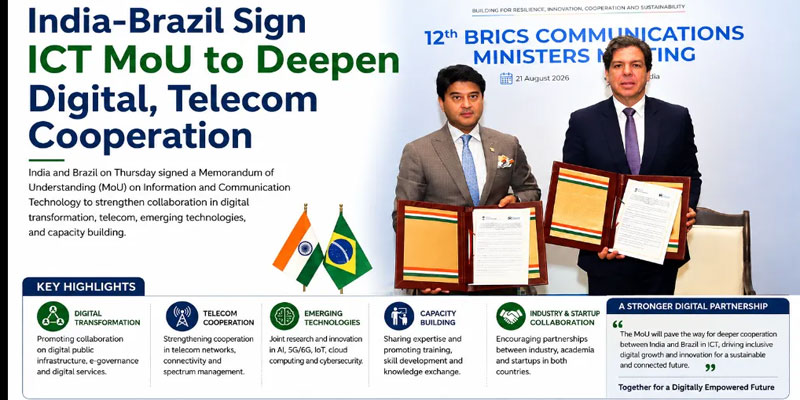
India and Brazil have taken a significant step towards expanding their strategic partnership into the digital domain by signing a memorandum of understanding (MoU) on telecommunications and information and communication technologies (ICTs). The agreement was signed in Pune during the 12th BRICS Communications Ministers Meeting by Union Communications Minister Jyotiraditya M. Scindia and Brazil’s Communications Minister Frederico de Siqueira Filho. The pact places cybersecurity, digital infrastructure, universal connectivity and emerging technologies at the centre of growing bilateral cooperation.
From Telecom Cooperation to Digital Partnership
The agreement comes as India uses its 2026 BRICS chairship to promote digital resilience, innovation and inclusive connectivity. The five-day BRICS ICT Track brought together discussions on artificial intelligence, next-generation communications, cybersecurity, digital skills, startups and resilient digital ecosystems.
The MoU reflects how telecom diplomacy has evolved. Cooperation now extends beyond traditional networks and spectrum management to digital public infrastructure (DPI), cloud systems, artificial intelligence, digital identity, online public services and protection of critical communications infrastructure.
India-Brazil Digital Partnership Gains Momentum
The new agreement builds on Brazilian President Luiz Inácio Lula da Silva’s state visit to India in February 2026, when both countries adopted a “Digital Partnership for the Future”. DPI, AI, high-performance computing, quantum technologies and blockchain were identified as priority areas, while the two sides supported establishing a Centre of Excellence for DPI in Brazil based on India’s experience with population-scale digital platforms.
The partnership is strengthened by complementary capabilities. India has developed large-scale digital identity and instant-payment systems, while Brazil’s Pix has emerged as a highly successful digital payments platform. Discussions over possible interoperability between India’s UPI and Pix could eventually enable faster and cheaper cross-border transactions, particularly for businesses, travellers and smaller enterprises.
Cybersecurity Becomes the Strategic Core
Cybersecurity could become the most consequential component of the partnership. Rapid digitisation of banking, healthcare, government services and industry has simultaneously expanded exposure to ransomware, financial fraud, data theft and attacks on critical infrastructure.
Cooperation in secure telecommunications, cyber incident response, fraud prevention and regulatory practices could strengthen both countries’ digital resilience. Their first bilateral cyber dialogue, held in Brasília in November 2025, provides an institutional foundation for deeper cooperation.
The MoU could also facilitate collaboration on 5G and 6G applications, satellite connectivity, quantum communications and digital services for underserved communities. However, its success will depend on implementation through joint projects, technical standards, financing, industry participation and compatible data-governance frameworks.
A Partnership with Wider Global-South Significance
For India, deeper cooperation with Brazil strengthens its ambition to emerge as a provider of digital public goods rather than merely a technology consumer. Sharing India’s DPI experience with another major Global South economy can also expand the international footprint of its digital governance model.
For Brazil, India provides an important source of technological expertise and an opportunity to diversify partnerships amid intensifying global competition over digital infrastructure and strategic technologies.
Turning Digital Intent into Strategic Capability
The India-Brazil telecom MoU is therefore more than a sectoral agreement. It reflects a broader transformation in bilateral relations, connecting digital infrastructure with economic development, cybersecurity and strategic autonomy. Its immediate impact may remain limited, but sustained implementation could create interoperable systems, stronger cyber defences and new technology partnerships.
For India, the larger opportunity lies in demonstrating that trusted, affordable and inclusive digital infrastructure can become a foundation for deeper Global South cooperation. The real test now is whether the Pune agreement moves beyond diplomatic intent to deliver secure networks, shared innovation and practical digital connectivity.
(With agency inputs)